Yield Farming Explained: A Beginner's Guide to DeFi Passive Income
Learn what yield farming is, compare top platforms (Aave, Pendle, Yearn), understand risks like impermanent loss, and start earning. A complete 2026 guide.
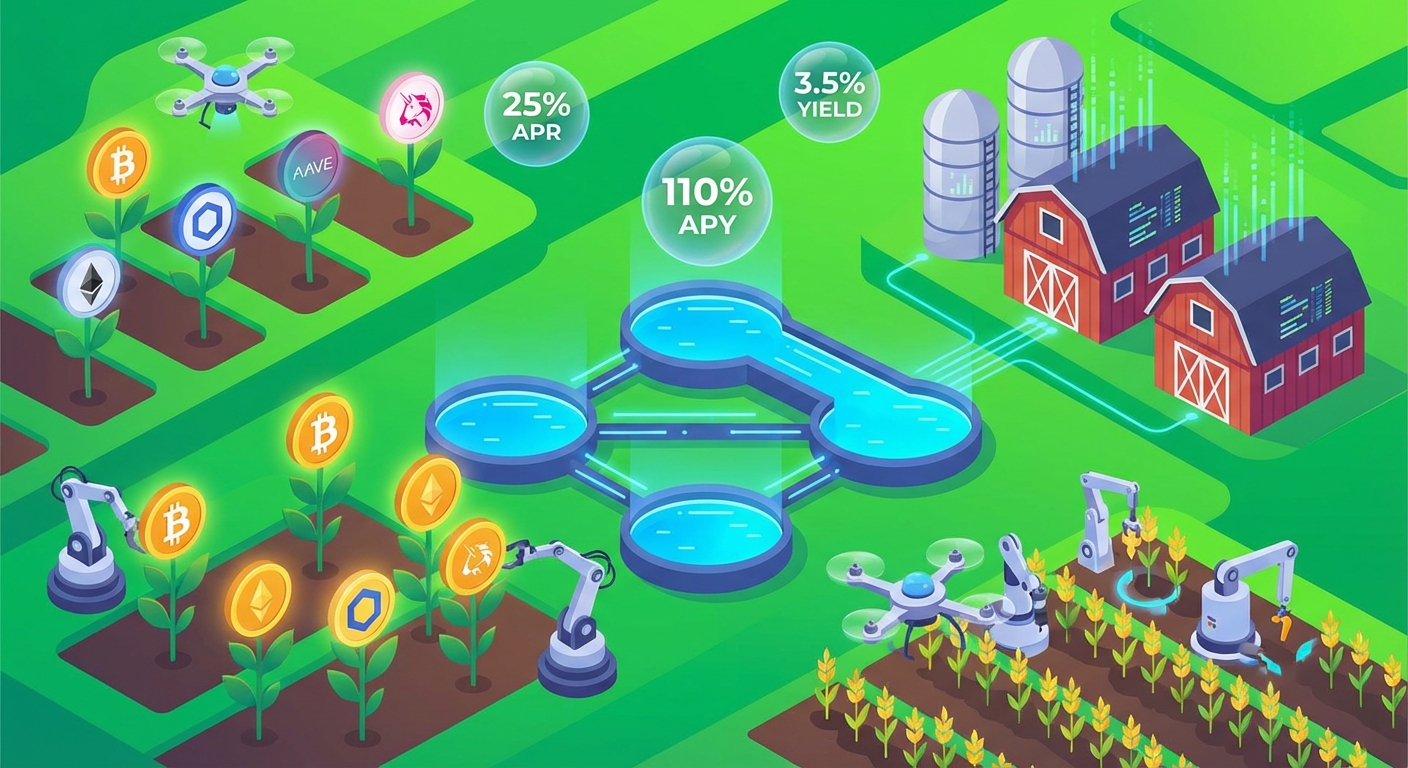
What Is Yield Farming?
Yield farming is the practice of depositing crypto assets into DeFi protocols to earn interest, fees, or reward tokens. Think of it as putting money in a savings account — except the "bank" is a smart contract, and returns range from 3% to 20%+ APY instead of the typical 1-3% from traditional banks.
How It Works
- Deposit: You supply crypto to a DeFi protocol
- Utilization: The protocol uses your assets for lending, trading liquidity, or other services
- Rewards: You earn a share of fees and interest generated
- Compounding: Reinvest rewards for exponential growth
5 Types of Yield Farming
1. Lending — Safest Entry Point
Deposit assets into lending protocols. Borrowers pay interest, which flows to you.
- Platforms: Aave, Compound, Morpho
- APY: 3-7% on stablecoins
- Risk: Low (your deposited asset doesn't change)
- Best for: Beginners seeking stable returns
Example: Supply USDC on Aave → earn 4-7% APY automatically
2. Liquidity Provision (LP) — Intermediate
Deposit token pairs into AMM pools and earn trading fees.
- Platforms: Uniswap, Curve, PancakeSwap
- APY: Stable pairs 5-15%, volatile pairs 10-50%+
- Risk: Medium (impermanent loss possible)
- Best for: Users who understand AMM mechanics
Example: Provide ETH/USDC liquidity on Uniswap V3 → earn trading fees + potential incentives
3. Yield Aggregation — Automated Optimization
Yield aggregators automatically route your assets to the highest-yielding strategies.
- Platforms: Yearn Finance, Beefy Finance
- APY: Stables 2-8%, LST pairs 3-8%
- Risk: Medium (multiple smart contract dependencies)
- Best for: Hands-off investors who want automated management
Yearn's Vaults deposit your assets and automatically rotate through Curve, Convex, Morpho, and others to maximize returns. Increasingly, AI agents are making this automation even more sophisticated.
4. Yield Tokenization — 2026's Hottest Trend
Split assets into their principal (PT) and yield (YT) components for separate trading.
- Platform: Pendle (peak TVL $8.27B)
- APY: 14.5% on Ethena sUSDe pools, fixed rates available
- Risk: Medium-high (structural complexity)
- Best for: Advanced users seeking fixed yields or yield speculation
Pendle's innovation: Buy PT to lock in a guaranteed fixed return at maturity — like a DeFi certificate of deposit. No yield volatility, no surprises.
5. Leveraged Yield Farming — High Risk
Borrow against deposits and re-deposit to amplify returns.
- Platforms: Alpaca Finance, Kamino
- APY: 2-5x base yield amplification
- Risk: Very high (liquidation risk)
- Best for: Experienced traders only
Top Platforms Compared (2026)
| Platform | TVL | Type | Stablecoin APY | Key Feature |
|---|---|---|---|---|
| Aave | ~$27B | Lending | 4-7% | Largest, most battle-tested |
| Compound | ~$3.5B | Lending | 2-5% | Simple interface |
| Pendle | ~$5B | Yield tokenization | 8-15% | Fixed-rate yields |
| Yearn | ~$1.5B | Aggregator | 2-8% | Auto-optimization |
| Curve | ~$2B | LP (stables) | 3-10% | Stablecoin specialist |
| Uniswap | ~$6.8B | LP (volatile) | 5-30%+ | Largest DEX |
Step-by-Step Beginner Guide
Step 1: Prepare
- Set up a crypto wallet (MetaMask or Rabby)
- Buy USDC or ETH on a centralized exchange
- Withdraw to your wallet (keep some ETH for gas fees)
- Start small ($50-$200)
Step 2: First Farm (Safe Route)
Recommended: Supply USDC on Aave
- Visit app.aave.com
- Connect your wallet
- Supply USDC
- Watch interest accrue in real time
- Earn 4-7% APY
This alone earns 2-3x more than traditional savings accounts.
Step 3: Try Liquidity Provision
Once comfortable with lending:
- Visit Curve Finance
- Supply to a USDC/USDT pool — same-value pairs minimize impermanent loss
- Earn 3-10% APY + CRV token rewards
Step 4: Compound Your Returns
- Reinvest earned rewards (CRV, COMP, etc.)
- Or deposit into Yearn Vaults for auto-compounding
- Regular harvesting: Claim rewards periodically to maximize compound effects
Risk Management: What You Must Know
Impermanent Loss
When you provide liquidity to an AMM pool, price changes between paired tokens can cause losses compared to simply holding. (Full guide →)
Quick example: Deposit into ETH/USDC pool → ETH price doubles → you lose ~5.7% compared to holding
| Price Change | Impermanent Loss |
|---|---|
| 1.25x | 0.6% |
| 1.5x | 2.0% |
| 2x | 5.7% |
| 3x | 13.4% |
| 5x | 25.5% |
How to mitigate:
- Use stablecoin pairs (USDC/USDT) → near-zero impermanent loss
- Choose pools where trading fees exceed impermanent loss
- Use correlated asset pairs (stETH/ETH)
Smart Contract Risk
Approximately $3.2 billion was stolen through hacks in 2024 alone.
How to protect yourself:
- Only use audited protocols
- Prioritize high-TVL, battle-tested protocols (Aave, Uniswap, Curve)
- Never put more than 30% of your portfolio in one protocol
Token Inflation Risk
Some protocols offer high APY through reward token emissions. If the token price drops, real returns can go negative.
How to protect yourself:
- If APY exceeds 100%, verify the yield source
- Prefer "Real Yield" — returns from actual protocol fees
- In 2026, 65% of Aave lending yields come from genuine borrowing demand
Rug Pulls
Unverified protocols where teams disappear with deposited funds.
How to protect yourself:
- Only use protocols listed on DeFiLlama and CoinGecko
- Check for team transparency and open-source code
- Test new protocols with small amounts first
2026 Yield Farming Trends
The Real Yield Era
Early DeFi's 1000%+ APYs were mostly token inflation. In 2026, sustainable yield from real economic activity is the standard:
- Lending interest: Actual borrowing demand → Aave
- Trading fees: Real trading volume → Uniswap, Hyperliquid
- RWA yields: Treasury interest, rental income → Pendle, Ondo
Pendle and Yield Tokenization
Pendle is the most innovative yield farming platform of 2026. By splitting yield into fixed vs variable:
- Conservative: Buy PT → guaranteed fixed return at maturity
- Aggressive: Buy YT → leveraged exposure to rising yields
Cross-Chain Farming
Beyond Ethereum, yield farming thrives on Solana, Arbitrum, Base, and other chains. L2 networks offer significantly lower gas fees, making yield farming accessible to smaller portfolios.
Frequently Asked Questions
How much can I earn from yield farming?
Safe strategies (Aave stablecoin lending) yield 4-7% annually. Medium-risk strategies (LP + incentives) can reach 10-20%. APYs above 100% are almost always unsustainable — approach with extreme caution.
What's the minimum to start?
Technically any amount works, but gas fees matter. On Ethereum mainnet, $500+ is practical. On L2s like Arbitrum or Base, you can start with $50-$100.
Is yield farming income taxable?
In most jurisdictions, yes. Receiving reward tokens may be taxable income, and selling them triggers capital gains. Keep records of all transactions and consult a tax professional.
Can I combine yield farming with airdrop farming?
Absolutely. DeFi protocol activity contributes to airdrop eligibility. Supplying assets on Aave earns interest while building protocol usage history for potential airdrops.
Disclaimer: This article is for informational purposes only and does not constitute investment advice. Yield farming carries risks including smart contract vulnerabilities, impermanent loss, and token price volatility. Always participate at your own discretion and risk. NFA/DYOR.