Gas Fees Explained: A Complete Guide to Blockchain Transaction Costs
Understand how blockchain gas fees work, compare costs across chains, and learn 7 tips to save. 2026 guide with Ethereum at historic low fees.
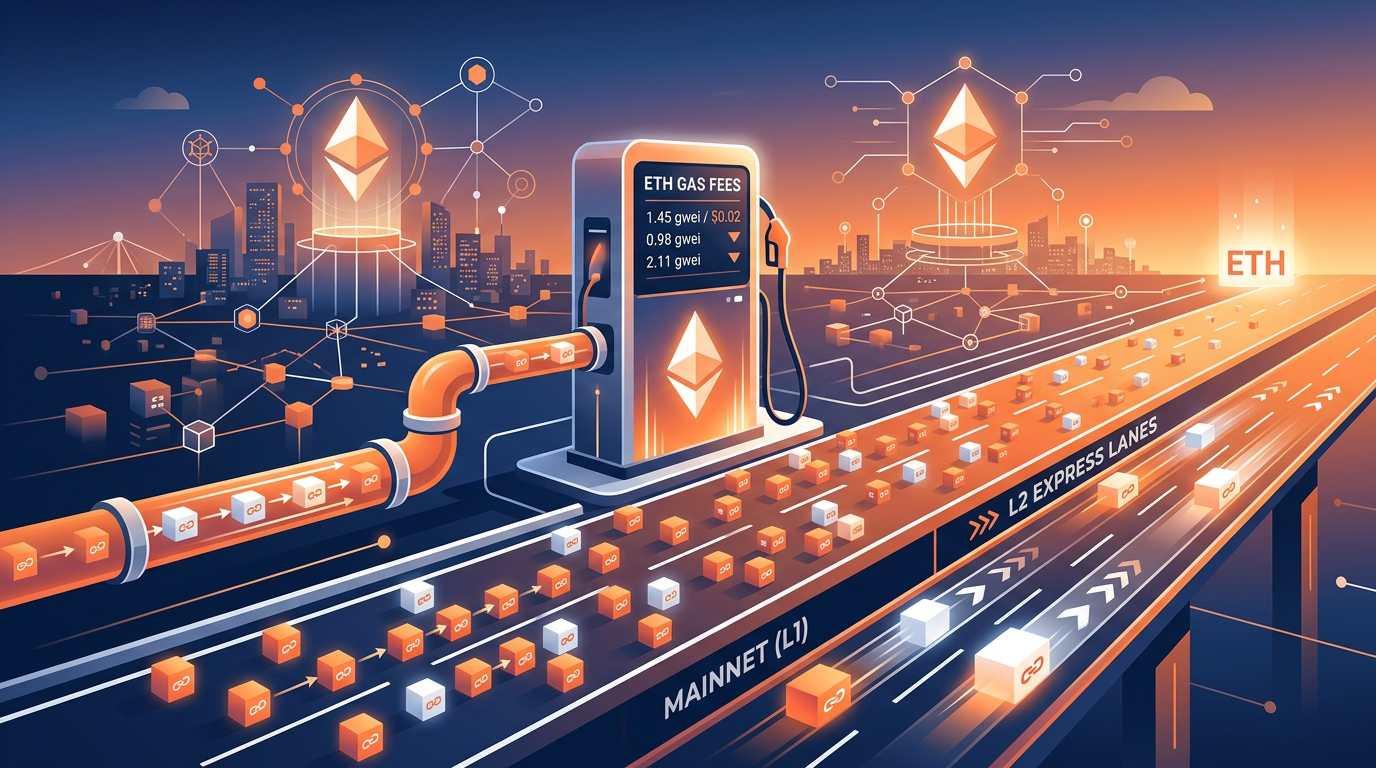
What Are Gas Fees?
To execute a transaction on a blockchain, you need to pay a gas fee — a processing charge paid to validators who maintain the network.
Think of it like this:
- Gas = fuel that powers a car
- Gas fee = the cost of buying that fuel
- Transaction = the trip to your destination
A simple ETH transfer is a short city drive (low fuel), while a complex DeFi smart contract interaction is a cross-country road trip (high fuel).
How Are Gas Fees Determined?
Ethereum's Gas Fee Structure (EIP-1559)
Since the 2021 London hard fork, Ethereum gas fees have three components:
1. Base Fee
- Automatically adjusted by the network
- Increases when blocks are more than 50% full, decreases when under 50%
- This fee is burned — permanently removed from ETH supply
2. Priority Fee (Tip)
- A voluntary tip to validators for faster processing
- Higher tip = faster transaction inclusion
- Set it low if you're not in a rush
3. Gas Limit
- The maximum computation a transaction can consume
- Simple ETH transfer: 21,000 gas
- ERC-20 token transfer: ~65,000 gas
- DEX swap: ~150,000-300,000 gas
- Complex DeFi operations: 500,000+ gas
The Gas Fee Formula
Gas Fee = (Base Fee + Priority Fee) × Gas Used
For example, with a base fee of 0.033 gwei and priority fee of 0.01 gwei, an ETH transfer (21,000 gas) costs:
(0.033 + 0.01) × 21,000 = 903 gwei ≈ $0.001
As of March 2026, that's essentially free.
The 2026 Gas Fee Revolution: Historic Lows
Ethereum gas fees have hit all-time lows in 2026.
Current Gas Fees (March 2026)
| Level | Gas (gwei) | Approx. Cost |
|---|---|---|
| Low | 0.033 | ~$0.001 |
| Average | 0.033 | ~$0.001 |
| High | 0.033 | ~$0.01 |
Fees dropped 93% year-over-year, while daily transactions hit a record 2.88 million. Lower fees actually drove more usage.
Why Did Fees Drop So Much?
1. EIP-4844 Blob Transactions (March 2024)
The Dencun upgrade introduced blob transactions — a game changer. L2 rollups got a separate, cheap data space, slashing L2 fees by 97%+.
2. Pectra Upgrade (May 2025)
Doubled blob throughput (target 3→6, max 6→9), further reducing L2 costs.
3. Fusaka Upgrade (December 2025)
Introduced PeerDAS technology, expanding blob capacity by up to 8x. Validators now sample blob data instead of downloading it entirely.
4. Block Gas Limit Increase
In November 2025, the block gas limit was raised from 45M to 60M, allowing more transactions per block.
5. L2 Migration
Most DeFi and NFT activity migrated to rollups, dramatically reducing mainnet congestion.
Gas Fee Comparison Across Chains
Average transaction costs across major blockchains as of March 2026:
| Chain | Simple Transfer | DEX Swap | NFT Mint |
|---|---|---|---|
| Ethereum L1 | ~$0.01-$0.15 | ~$0.20-$0.50 | ~$0.50-$1.00 |
| Arbitrum | ~$0.008-$0.05 | ~$0.03 | ~$0.05 |
| Optimism | ~$0.009-$0.05 | ~$0.03 | ~$0.05 |
| Base | ~$0.01-$0.05 | ~$0.03 | ~$0.05 |
| Polygon | ~$0.01 | ~$0.02 | ~$0.10 |
| Solana | ~$0.00025 | ~$0.001 | ~$0.005 |
Which Chain Should You Use?
- Frequent small transactions: Solana or Base (near-zero fees)
- Main DeFi activity: Arbitrum, Optimism (Ethereum security + low fees)
- Large transactions: Ethereum L1 (maximum security and liquidity)
- Airdrop farming: Multi-chain activity is advantageous
7 Tips to Save on Gas Fees
1. Use L2 Rollups
Switch from Ethereum mainnet to Arbitrum, Base, or Optimism for 95%+ savings. Post-EIP-4844 L2 fees are dramatically lower. See the cross-chain bridge guide for how to move assets safely.
2. Time Your Transactions
Send transactions during low-activity periods:
- Best times: Early morning UTC (weekdays) or weekends
- Use gas trackers to monitor real-time prices
3. Batch Transactions
Wallets supporting ERC-4337 (account abstraction) let you bundle multiple transactions into one. Over 40 million smart accounts are deployed as of 2026.
4. Set Appropriate Gas
You can manually configure gas in your wallet:
- Urgent transactions: higher priority fee
- Can wait: lower priority fee (slightly longer processing)
- Set a max fee to prevent overpaying
5. Use Gas Trackers
Check Etherscan Gas Tracker for real-time fees. Waiting out a spike can save significant costs.
6. Optimize Token Approvals
Token approvals for DeFi protocols cost gas too. Approve only the amount you need instead of unlimited — it's better for security and saves gas on future revocations.
7. Leverage Gasless Transactions
Some protocols and wallets offer gas sponsorship. Account abstraction technology enables services where users don't pay gas directly — the protocol covers it.
Gas Fees and ETH Burning: The Deflation Effect
Since EIP-1559, all base fees are burned. Higher fees = more ETH burned = lower supply.
However, with 2026's record-low fees, burn rates have dropped, and ETH supply has returned to a net inflationary trend. This is a significant variable in Ethereum's economic model.
Frequently Asked Questions
What happens if I don't pay enough gas?
Your transaction won't be processed. If the gas fee is too low, it sits in the mempool (waiting queue) until it eventually gets dropped.
Can gas fees get expensive again?
Extreme network congestion can cause temporary spikes. But with L2 scaling and ongoing protocol upgrades, a return to past levels ($50-$100+ per transaction) is unlikely.
Does Bitcoin have gas fees?
Bitcoin doesn't use the term "gas fees," but it does have transaction fees based on transaction size (in bytes). As of March 2026, average BTC transaction fees are approximately $1-$5.
Why is Solana so cheap?
Solana uses a fundamentally different consensus mechanism (Proof of History + Proof of Stake) and architecture. Its high throughput (~4,000+ TPS) and parallel transaction processing keep per-transaction costs at ~$0.00025. With the upcoming Firedancer and Alpenglow upgrades, Solana aims to push throughput to 1M TPS while cutting finality to 150ms.
Disclaimer: This article is for informational purposes only and is not financial advice. Gas fees fluctuate in real time based on network conditions. Always check current fees before executing transactions. NFA/DYOR.