Impermanent Loss Explained: The Hidden Risk of DeFi Liquidity
Learn what impermanent loss is, how to calculate it, and how to minimize it in 2026. From the IL formula to Uniswap V4 hooks and options hedging — a complete guide.
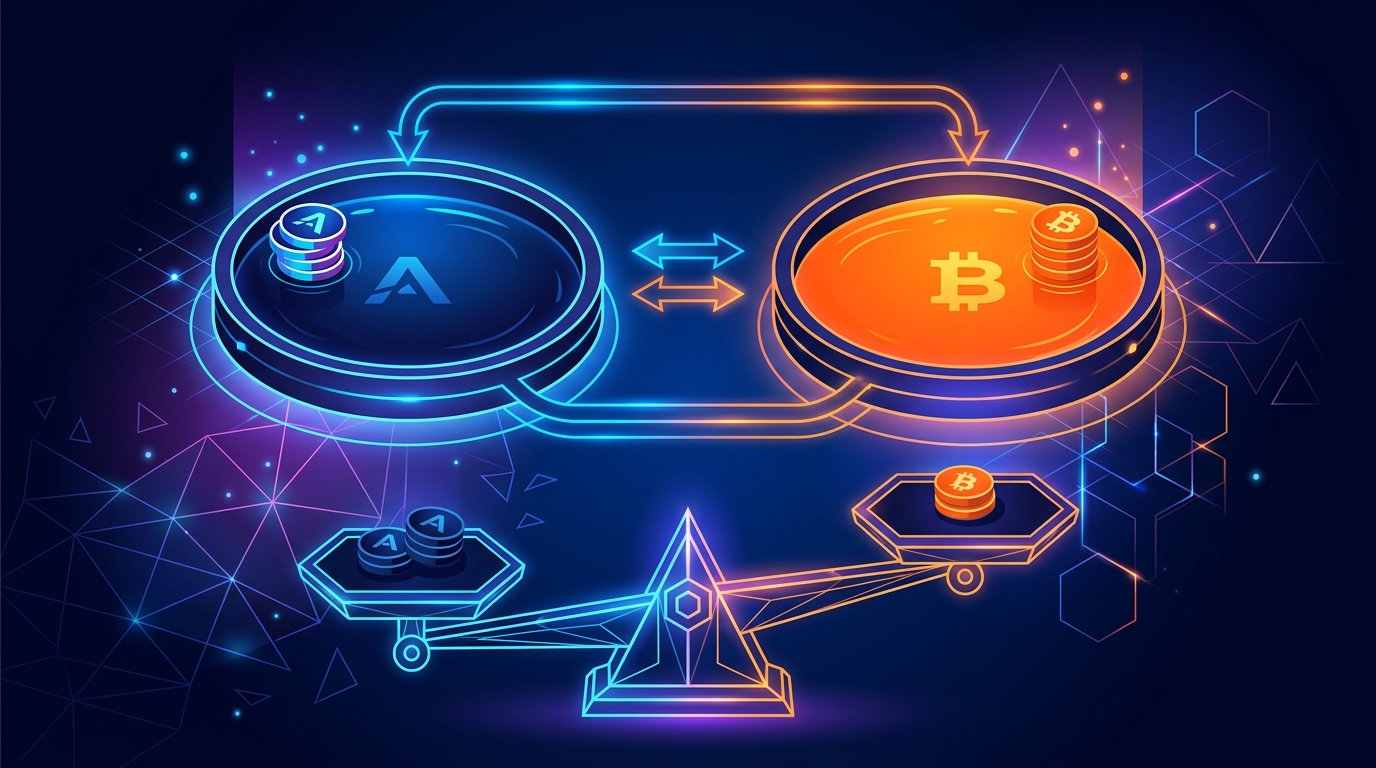
What Is Impermanent Loss?
Impermanent loss (IL) is the difference in value between holding tokens in an AMM liquidity pool versus simply holding them in your wallet. When the price of pooled assets changes relative to each other, the pool's automatic rebalancing leaves you with less value than a basic buy-and-hold strategy.
Why "impermanent"? Because if prices return to their original ratio, the loss disappears. But if you withdraw at a different price ratio, the loss becomes permanent.
54.7% of Uniswap V3 LPs in volatile pairs have lost money due to IL exceeding their fee income. Understanding this risk is essential before providing liquidity in any DeFi protocol.
Why Does IL Happen?
AMMs use the constant product formula (x × y = k) to price assets.
- You deposit 1 ETH + 2,000 USDC into a pool (ETH = $2,000)
- ETH price rises to $4,000 on external exchanges
- Arbitrageurs buy cheap ETH from the pool until prices equalize
- The pool rebalances: less ETH, more USDC (it "sold the winner, bought the loser")
- Your share is now worth less than if you'd simply held
The core mechanism: AMMs always maintain a 50:50 value ratio, which means they systematically reduce your exposure to appreciating assets and increase exposure to depreciating ones.
The IL Formula
For a standard 50/50 AMM pool:
IL = 2 × √r ÷ (1 + r) - 1
Where r = price ratio (new price / original price).
IL by Price Change
| Price Change | IL | Interpretation |
|---|---|---|
| ±0% | 0% | No change, no loss |
| +25% | -0.6% | Negligible |
| +50% | -2.0% | Usually offset by fees |
| +100% (2x) | -5.72% | Significant — monitor closely |
| +200% (3x) | -13.4% | Substantial loss |
| +400% (5x) | -25.5% | Severe loss |
| -50% | -5.72% | Same IL as 2x increase |
| -75% | -20.0% | Principal loss + IL |
Key property: IL is symmetrical — it depends only on the magnitude of price divergence, not the direction. A 50% drop and a 100% increase produce identical IL (5.72%).
Worked Example: ETH/USDC Pool
Setup
- Deposit: 1 ETH + 2,000 USDC (total value: $4,000)
- ETH price change: $2,000 → $4,000 (2x)
In the Liquidity Pool
The constant product formula rebalances:
- Pool position: 0.707 ETH + 2,828 USDC = $5,656
Holding in Wallet
- Wallet value: 1 ETH ($4,000) + 2,000 USDC = $6,000
Impermanent Loss
- Difference: $6,000 - $5,656 = $344 (5.72%)
- If trading fees earned during this period exceed $344, you're still profitable. If not, you've underperformed a simple hold.
V2 vs V3/V4: How Concentrated Liquidity Amplifies IL
V2 (Full Range)
Liquidity is spread across the entire price range (0 to ∞).
- IL follows the standard formula above
- Capital inefficient but requires no active management
V3/V4 (Concentrated Liquidity)
LPs set custom price ranges for higher capital efficiency.
- Tighter ranges = higher fee income BUT amplified IL
- If price exits your range: zero fee income + maximum IL (100% converted to the less valuable asset)
- JIT (Just-In-Time) liquidity: Sophisticated traders add and remove liquidity around large trades, eroding passive LP profits by up to 44% per trade
The Statistics
- 54.7% of Uniswap V3 LPs in volatile pairs lost money (MEXC Research)
- Only 37.2% of non-stablecoin positions ended profitably
- ETH/USDC 0.3% pool: average IL of ~1.2% over 30 days with 40% price swing
- 67% of V3 LPs in volatile pairs were underwater due to unmanaged ranges
How to Minimize Impermanent Loss
1. Choose Stablecoin Pairs
Stablecoin pairs like USDC/USDT or DAI/USDC have minimal price divergence, keeping IL near zero. Lower yields, but predictable.
2. Pick Correlated Pairs
Assets that move together — ETH/stETH, wBTC/renBTC — experience minimal IL since their price ratio stays relatively stable.
3. Target High-Volume Pools
Pools with high daily volume relative to TVL (>10% daily turnover) generate fees that can outpace IL. The ETH/USDC 0.3% pool with $1M+ daily volume yields approximately 11% APY.
4. Use Automated Liquidity Managers (ALMs)
In 2026, automated position management has become standard:
- Gamma Strategies: Auto-rebalances price ranges to minimize IL while maximizing fee capture across multiple DEXs and chains
- Arrakis Finance: Non-custodial vault management for Uniswap V3 concentrated liquidity positions
5. Options-Based Hedging
DeFi options protocols can directly hedge IL exposure:
- Panoptic: Perpetual options built on Uniswap V3/V4. Take opposing positions to LP exposure, effectively neutralizing IL. Backed by Uniswap Labs Ventures, Coinbase Ventures, and Jane Street.
- GammaSwap: Short LP tokens to create impermanent gain (the mirror image of IL). Enables volatility speculation and IL hedging.
6. Uniswap V4 Hooks
V4's programmable hook system enables custom IL mitigation strategies:
- Dynamic Fee Hooks: Auto-increase fees during high volatility to boost LP compensation
- Options Hedging Hooks: Automatically purchase call options within hook logic to hedge LP positions
IL vs Yield Farming Returns
IL doesn't mean LP is always unprofitable. The key question is whether fee income + incentives exceed IL.
| Scenario | Fee APY | IL | Net Return |
|---|---|---|---|
| ETH/USDC (V3, high volume) | ~11% | -5.72% | +5.28% |
| Small alt/ETH pair | ~3% | -13.4% | -10.4% |
| USDC/USDT (stablecoin) | ~4% | -0.01% | +3.99% |
Pre-LP Checklist
- Check pair volatility: Review 30-day max price deviation
- Verify pool volume: Daily volume >10% of TVL indicates healthy fee generation
- Understand fee tier: 0.05% (stables) / 0.3% (majors) / 1% (alts)
- Simulate IL: Use DailyDeFi IL Calculator before committing
- Factor in gas fees: Entry/exit costs can eat into profits
- Smart contract risk: Only use audited protocols
- Size appropriately: Allocate only a portion of your portfolio to LP positions
DeFi Series
Understanding impermanent loss builds on these foundational concepts:
- What is DeFi? — DeFi fundamentals
- AMM and Liquidity Pools — How automated market makers work
- Yield Farming Guide — Earning strategies
- DEX vs CEX — Exchange comparison
Final Thoughts
Impermanent loss is the most important risk in DeFi liquidity provision. But it's a manageable risk — with the right pair selection, automated tools, and options hedging strategies.
The LP protection infrastructure is maturing rapidly in 2026, with Uniswap V4 hooks, Panoptic's perpetual options, and AI-powered dynamic hedging. Delphi Digital projects that by 2027, 75% of liquidity provision will happen through structured products that guarantee net-positive returns.
The bottom line: understand IL and it becomes a tool for DeFi yield; ignore it and it becomes an invisible drain on your capital.
Disclaimer: This article is for informational purposes only and does not constitute investment advice. DeFi liquidity provision carries risks including impermanent loss, smart contract vulnerabilities, and market risk. Always do your own research before participating.