AI Agents in Crypto: How They Work and Why They Matter
Learn what crypto AI agents are, how they automate DeFi, and why ERC-8183 matters. A 2026 guide to the $15B+ AI x crypto market and the rise of DeFAI.
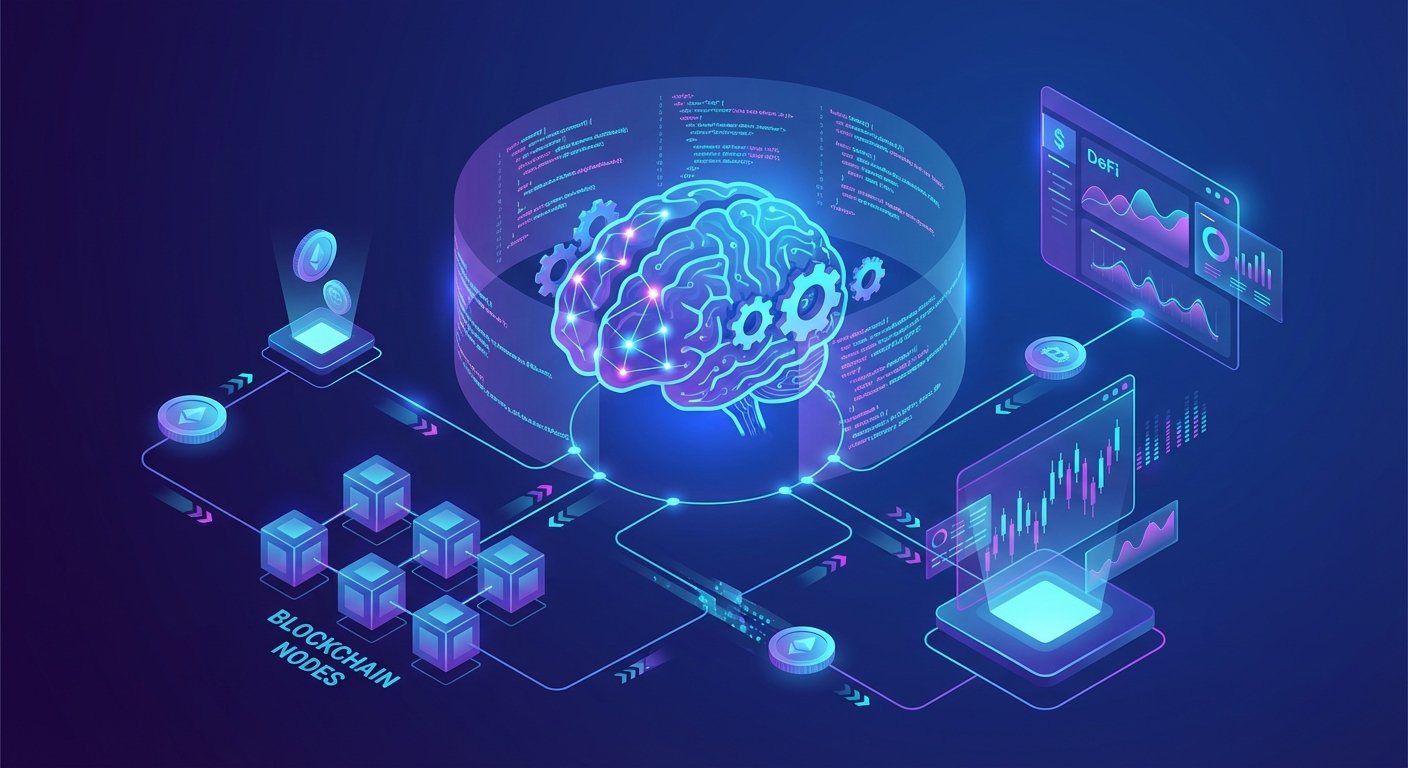
What Are AI Agents?
AI agents are autonomous programs that perceive, reason, and act without human intervention. While a chatbot answers questions, an AI agent analyzes data, develops strategies, and executes them — all on its own.
In crypto, AI agents operate on blockchain networks and can autonomously:
- Trade: Analyze market data and execute swaps on DEXs
- Manage DeFi: Optimize yield farming positions and rebalance
- Research: Combine on-chain analytics with social media sentiment
- Portfolio management: Automatically adjust asset allocations
Why Blockchain + AI?
AI agents are uniquely powerful on blockchain compared to traditional finance:
| Feature | Traditional Finance | Blockchain |
|---|---|---|
| Data access | API-restricted, paywalled | Fully open on-chain data |
| Trade execution | Requires broker/intermediary | Direct smart contract interaction |
| Asset control | Bank account integration | Direct wallet control |
| Operating hours | Weekday business hours | 24/7/365 |
| Transparency | Black box | Every transaction recorded on-chain |
Blockchain's permissionless nature means AI agents can interact with smart contracts directly — no identity verification or account setup required.
How AI Agents Work
The 3-Step Process
1. Perception
   ↓ On-chain transactions, price feeds, social media
2. Reasoning
   ↓ AI model identifies patterns, formulates strategy
3. Action
   → Smart contract calls, token swaps, position adjustments
Core Components
- AI Model: Large language models (GPT, Claude, etc.) serve as the reasoning engine
- On-chain Wallet: A crypto wallet the agent directly controls
- Tools: Modules for DEX swaps, lending protocols, bridges, and other blockchain operations
- Memory: Storage for past transaction history and learned patterns
AI Agent Market in 2026
The AI x crypto narrative has exploded since late 2025:
| Metric | Value |
|---|---|
| AI agent market size | $15B+ |
| AI crypto category market cap | $13.7B |
| Projected growth | $250B (analyst estimates) |
| ERC-8183 launch | February 2026 |
| Key frameworks | ElizaOS, Virtuals Protocol |
NEAR co-founder stated that "the primary users of blockchain will be AI agents" — a view gaining broad consensus across the crypto industry.
DeFAI: The Fusion of DeFi and AI
DeFAI (Decentralized Finance + AI) is one of the hottest crypto narratives of 2026.
The Problem DeFAI Solves
DeFi is powerful but has steep barriers to entry:
- Complex protocol interfaces to learn
- Gas fee optimization and slippage management
- Manual switching between protocols
- Risk monitoring for impermanent loss and liquidations
AI agents automate all of this. A user can simply say "Earn me the best yield on $1,000 USDC" and the agent will:
- Compare yield farming rates across Aave, Compound, Pendle
- Deploy capital to the optimal protocol
- Auto-rebalance when yields shift
- Execute during low gas fee windows
Key DeFAI Use Cases
| Use Case | Description | Example |
|---|---|---|
| Auto yield farming | Automated yield optimization | Yearn v3 AI vaults |
| Trading bots | Market analysis + auto execution | AI-powered DEX trading |
| Risk management | Liquidation monitoring + auto response | Loan position management |
| Airdrop farming | Airdrop condition analysis + auto execution | Protocol interaction automation |
ERC-8183: The AI Agent Commerce Standard
In February 2026, Virtuals Protocol and the Ethereum Foundation's dAI team jointly released ERC-8183 — a groundbreaking standard enabling trustless commerce between AI agents.
How ERC-8183 Works
Previously, AI agents needed to trust a centralized platform to transact with each other. ERC-8183 solves this through smart contracts:
Client Agent → Creates Job + Escrows Funds
                    ↓
Provider Agent → Performs Work + Submits Deliverable
                    ↓
Evaluator → Verifies Output (AI / Smart Contract / Multisig)
                    ↓
Smart Contract → Automatic Settlement
Three Roles
- Client: Commissions work and escrows funds in the smart contract
- Provider: Performs the task and submits deliverables
- Evaluator: Verifies deliverables and triggers fund release or refund
Synergy with ERC-8004
ERC-8183 integrates with ERC-8004 (Agent Identity and Reputation Standard). Every completed job is recorded on-chain, building a portable reputation system for AI agents.
Top AI Agent Projects
Infrastructure & Frameworks
| Project | Description | Key Feature |
|---|---|---|
| Virtuals Protocol (VIRTUAL) | AI agent launch platform | ERC-8183 co-developer, Base chain |
| ElizaOS | Open-source AI agent framework | Powers ai16z DAO, can deploy NFTs & tokens |
| Bittensor (TAO) | Decentralized AI network | Subnet architecture, AI model marketplace |
| NEAR Protocol | AI-native L1 blockchain | Chain abstraction + AI agent integration |
Trading & DeFi Agents
| Project | Function | Supported Chains |
|---|---|---|
| Griffain | Natural language DeFi execution | Solana |
| Wayfinder (PROMPT) | AI agent navigation | EVM chains |
| Autonolas (OLAS) | Multi-agent systems | Multi-chain |
Practical Guide: Getting Started
1. Using AI Trading Bots
The easiest entry point is AI-powered trading platforms:
- Prepare a wallet (MetaMask or Phantom)
- Connect your wallet to an AI agent platform
- Set strategy parameters (risk tolerance, investment amount, target tokens)
- Start with a small amount and monitor performance
2. DeFAI Yield Optimization
Automate yield farming with AI agents:
- Deposit stablecoins into an AI vault
- The agent automatically allocates across optimal protocols
- Auto-rebalances when yield rates shift
3. Build Your Own Agent
Use open-source frameworks like ElizaOS to build custom agents:
- X (Twitter) sentiment analysis bots
- On-chain airdrop opportunity scanners
- AMM position auto-managers
Risks and Precautions
Technical Risks
- Smart contract bugs: Vulnerabilities in contracts the agent interacts with
- AI hallucinations: Incorrect judgments leading to losses
- Prompt injection: Malicious inputs that manipulate agent behavior
- Key management: Security risks when granting agents wallet access
Financial Risks
- Market risk: AI can't always handle sudden market crashes
- Overfitting: Strategies optimized for past data may fail in the future
- Liquidity risk: Agent bulk selling in thin markets causes slippage
- Regulatory risk: Regulations around AI auto-trading remain uncertain
Safety Checklist
- Start small: Verify agent performance with minimal capital first
- Limit permissions: Grant agents minimum necessary wallet access
- Separate wallets: Use a dedicated wallet for agents, separate from your main seed phrase
- Monitor actively: Review agent activity regularly
- Set stop-losses: Configure maximum loss thresholds
FAQ
Are AI agents better at trading than humans?
In specific conditions, yes. AI can monitor markets 24/7 and execute without emotion. However, they can suffer massive losses during unpredictable black swan events. Use AI agents as tools, not as infallible replacements for human judgment.
Should I invest in AI agent tokens?
AI agent tokens (VIRTUAL, TAO, OLAS, etc.) exhibit high volatility. Research the project's actual usage, development activity, and team capabilities before deciding — and only invest within your risk tolerance.
What does ERC-8183 mean for the future?
It's the first Ethereum standard to formalize commerce between AI agents. Agents can now commission work, verify results, and settle payments without any centralized platform. This lays the foundation for the Agentic Economy — a future where AI agents are primary economic actors on-chain.
Disclaimer: This article is for informational purposes only and does not constitute investment advice. AI agent projects are early-stage and carry significant risks. Always participate at your own discretion and risk. NFA/DYOR.