Layer 1 vs Layer 2: Key Differences and Top Projects
Understand the difference between Layer 1 and Layer 2 blockchains. Compare rollup types, top L2 networks like Arbitrum and Base, and learn the 2026 scaling landscape.
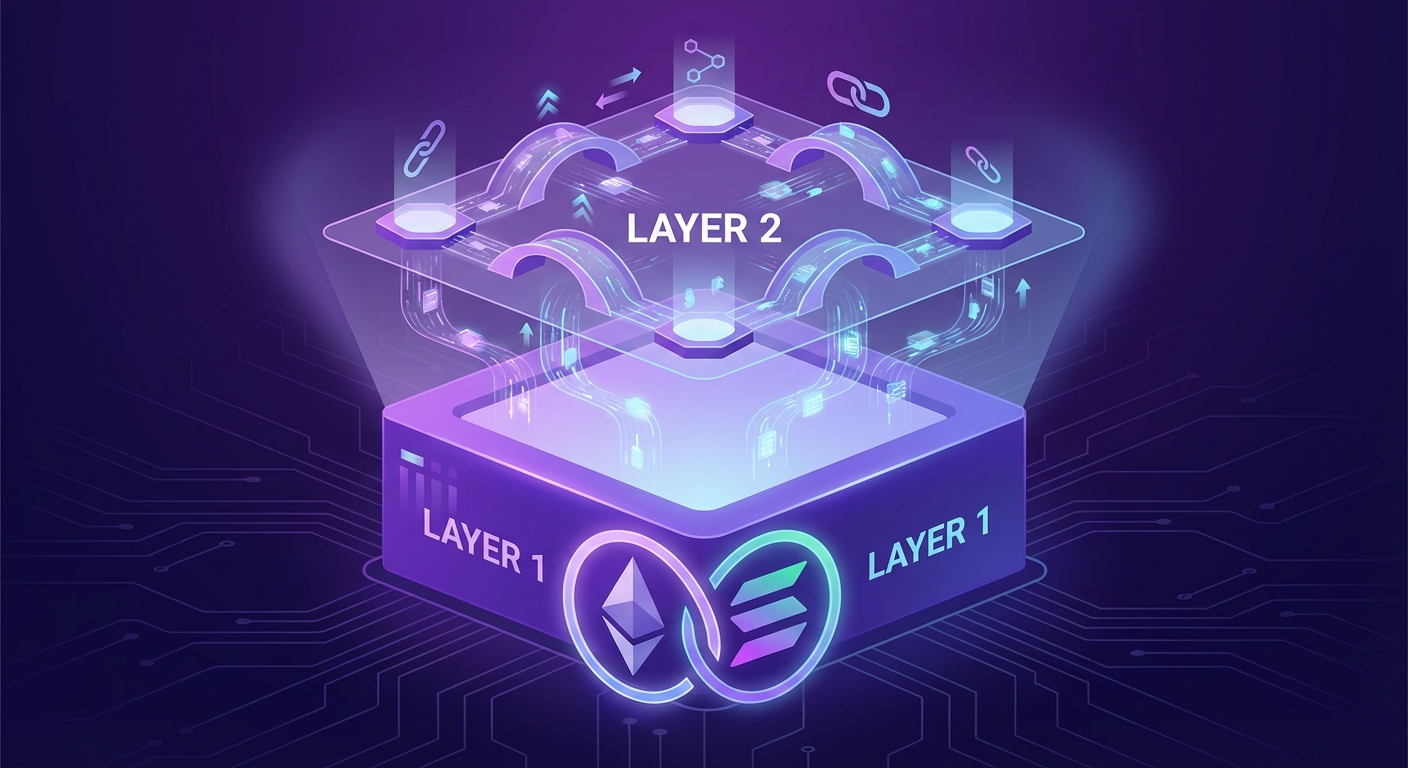
Why Layers Exist
Blockchains face a fundamental trade-off between security, decentralization, and scalability — the so-called Blockchain Trilemma.
Ethereum chose security and decentralization, which limits it to roughly 30 transactions per second. During the 2021 NFT boom, gas fees spiked to hundreds of dollars per transaction. That's the scalability problem.
Layer 2 (L2) networks were built to solve it.
Layer 1 vs Layer 2: The Basics
Layer 1 (L1) — The Base Chain
A Layer 1 is an independent blockchain with its own consensus algorithm and network.
- Validates transactions and produces blocks independently
- Directly responsible for network security
- Examples: Bitcoin, Ethereum, Solana, BNB Chain, Avalanche
Layer 2 (L2) — The Scaling Solution
A Layer 2 is built on top of a Layer 1, offloading transaction processing to improve speed and cost.
- Inherits L1 security while dramatically improving throughput
- Bundles transactions and settles them on L1
- Examples: Arbitrum, Base, Optimism, zkSync, Starknet
A Simple Analogy
Think of L1 as a highway. When traffic increases, congestion worsens and tolls (gas fees) rise.
L2 is like a high-speed rail line built above the highway. It carries passengers (transactions) quickly and cheaply, then settles at the final destination (L1).
Key Comparison
| Aspect | Layer 1 (Ethereum) | Layer 2 (Arbitrum, etc.) |
|---|---|---|
| TPS | ~30 | ~2,000–4,000 |
| Gas fees | $0.01–$0.50 | $0.001–$0.05 |
| Finality | ~12 minutes | Seconds |
| Security | Self-secured (1M+ validators) | Inherited from L1 |
| Decentralization | High | Dependent on L1 |
| Independence | Fully independent | Dependent on L1 |
How Layer 2 Works: Rollups
In 2026, most L2s use rollup technology — bundling hundreds or thousands of transactions into a single submission to L1.
Optimistic Rollups
"Trust first, prove fraud if needed"
- Execute transactions on L2
- Submit results to L1 — assumed valid
- 7-day challenge period begins
- If fraud is detected, a fraud proof is submitted
- Invalid transactions are reversed
Pros: High EVM compatibility, easy to port existing DApps Cons: 7-day withdrawal delay to L1
Key projects: Arbitrum, Optimism, Base
ZK Rollups (Zero-Knowledge)
"Prove mathematically, confirm instantly"
- Execute transactions on L2
- Generate a ZK proof mathematically proving validity
- Submit proof + data to L1 — immediately confirmed
- No challenge period needed
Pros: No withdrawal delay, theoretically more secure Cons: Higher computational cost for proof generation, complex EVM compatibility
Key projects: zkSync Era, Starknet, Polygon zkEVM, Scroll
Rollup Comparison
| Aspect | Optimistic Rollup | ZK Rollup |
|---|---|---|
| Verification | Fraud proof (challenge) | Validity proof (math) |
| Withdrawal time | ~7 days | Minutes to hours |
| EVM compatibility | High | Improving |
| Current TVL | ~$186B | ~$20B |
| Cost | Very low | Low (proof cost exists) |
| Leaders | Arbitrum, Base | zkSync, Starknet |
Top L2 Projects in 2026
Arbitrum
| Metric | Value |
|---|---|
| TVL | ~$16.6B |
| Daily transactions | 2M+ |
| Rollup type | Optimistic |
| Key strength | Largest DeFi ecosystem, Stylus (Rust/C++ support) |
Arbitrum maintains the #1 L2 TVL position with the richest DeFi ecosystem. Arbitrum Orbit enables developers to build custom L3 chains.
Base
| Metric | Value |
|---|---|
| TVL | ~$10B |
| Daily transactions | 3M+ |
| Rollup type | Optimistic (OP Stack) |
| Key strength | Coinbase integration, social/NFT ecosystem, fastest growth |
The fastest-growing L2 in 2025–2026. Coinbase integration makes onboarding seamless, with a thriving social DApp and NFT ecosystem.
Optimism
| Metric | Value |
|---|---|
| TVL | ~$6B |
| Daily transactions | 1M+ |
| Rollup type | Optimistic |
| Key strength | OP Stack framework, Superchain vision |
OP Stack powers dozens of L2s including Base, Worldcoin, and Zora — creating the Superchain ecosystem.
zkSync Era
| Metric | Value |
|---|---|
| TVL | ~$1B |
| Rollup type | ZK Rollup |
| Key strength | Native account abstraction, ZK-based security |
The most active ZK rollup ecosystem. No 7-day withdrawal wait, but the ecosystem is still smaller than optimistic rollup competitors.
L1 Fights Back: Native Scaling
L2s aren't the only ones scaling. L1 chains are pushing their own performance limits:
| L1 Chain | Scaling Strategy | Current TPS | Target |
|---|---|---|---|
| Ethereum | Rollup-centric roadmap + sharding | ~30 | L2 combined 100,000+ |
| Solana | Maximize L1 performance | ~4,000+ | 1,000,000 TPS |
| Sui | Parallel execution (Move VM) | ~120,000 | 300,000+ |
| Monad | Parallel EVM execution | ~10,000 | 10,000+ |
Ethereum adopted a rollup-centric roadmap — L1 focuses on security and data availability while L2s handle execution. Solana takes the opposite approach, pushing L1 performance to theoretical limits.
Real-World Cost Comparison (March 2026)
| Operation | Ethereum L1 | Arbitrum | Base |
|---|---|---|---|
| ETH transfer | ~$0.10 | ~$0.008 | ~$0.01 |
| DEX swap | ~$0.30 | ~$0.03 | ~$0.03 |
| NFT mint | ~$0.50 | ~$0.05 | ~$0.05 |
EIP-4844 (blob transactions) reduced L2 gas fees by over 97%.
Which Chain Should You Use?
Ethereum L1: Large value transfers requiring maximum security
Arbitrum: DeFi activity (richest L2 DeFi ecosystem) — GMX, Aave, Uniswap
Base: Easy onboarding from Coinbase, social DApps, NFTs, airdrop farming
Solana: Ultra-low-cost transactions, memecoin and NFT trading, mobile-first
L2 Risks and Considerations
Bridge Risk
Moving assets from L1 to L2 requires a bridge, which can be a hacking target:
- Use official bridges (Arbitrum Bridge, Base Bridge, etc.)
- Split large transfers across multiple transactions
- For third-party bridges, stick to verified protocols (Across, Stargate)
Withdrawal Delays
Optimistic rollups require a 7-day wait for L1 withdrawals. For urgent needs:
- Use fast bridge services (Across, Hop) — fees apply
- ZK rollups have no waiting period
Liquidity Fragmentation
The same token can be spread across multiple L2s, leading to different liquidity levels and prices per chain. Understanding AMM and liquidity pool mechanics helps navigate this.
2026 L2 Trends
Superchain and L2 Alliances
OP Stack-based chains are forming the Superchain — an interconnected network with cross-chain interoperability. Base, Worldcoin, and Zora are among participants.
L3 Emergence
Application-specific L3 chains are being built on top of L2s, optimized for gaming, social, and other specialized use cases with ultra-low costs.
Based Rollups
A new architecture delegating sequencing to L1 (Ethereum) for enhanced decentralization is under active research.
Summary
| Aspect | Layer 1 | Layer 2 |
|---|---|---|
| Role | Security, consensus, final settlement | Execution, speed, cost reduction |
| Analogy | Supreme Court (final ruling) | District Court (fast processing) |
| Best for | Large funds, maximum security | Daily transactions, DeFi, NFTs |
| 2026 trend | Data availability expansion | Interoperability, L3 expansion |
The blockchain ecosystem is evolving toward L1 and L2 collaboration, not competition. Ethereum provides the security foundation while L2s handle execution — a division of labor that will only strengthen. Prepare your wallet, understand each chain's strengths, and optimize your on-chain activity accordingly.
Disclaimer: This article is for informational purposes only and does not constitute investment advice. Investment decisions regarding any blockchain or token should be made based on your own judgment and research. NFA/DYOR.