What Is DeFi? A Complete Guide to Decentralized Finance
Learn what DeFi is, how it works, top protocols by TVL, and how to get started. A 2026 beginner's guide to decentralized finance with real market data.
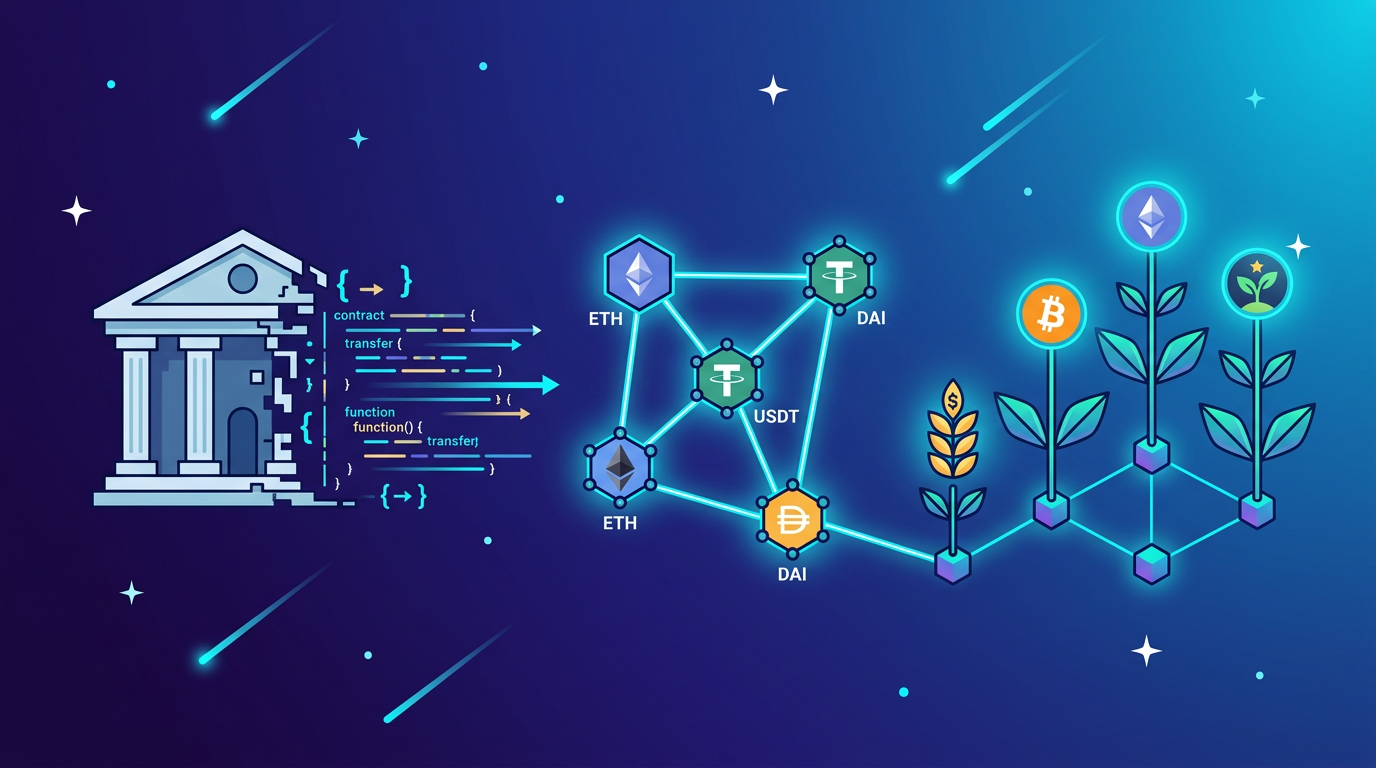
What Is DeFi?
DeFi stands for Decentralized Finance — a system of financial services built on blockchain and smart contracts that operates without banks, brokerages, or other intermediaries.
In traditional finance, borrowing money means visiting a bank, submitting paperwork, and waiting for approval. In DeFi, you connect your wallet, deposit collateral, and receive a loan in seconds — all executed automatically by code. It runs 24/7, 365 days a year.
Traditional Finance vs DeFi
| Feature | Traditional Finance (CeFi) | DeFi |
|---|---|---|
| Intermediary | Banks, brokerages | Smart contracts |
| Operating hours | Business hours (Mon-Fri) | 24/7/365 |
| Access | Bank account, KYC required | Just a wallet |
| Transparency | Internal ledgers (private) | All transactions public on-chain |
| Yields | Savings interest 1-3% | Stablecoin APY 4-7%+ |
| Processing time | 1-3 business days | Seconds to minutes |
How Does DeFi Work?
DeFi is built on three core components:
1. Blockchain
The infrastructure layer. Ethereum is the most established, but DeFi also thrives on Solana, Arbitrum, Base, and other chains. Blockchains record every transaction transparently and immutably.
2. Smart Contracts
Think of them as self-executing agreements. Conditions like "if user deposits X collateral, issue Y loan" are written in code. When conditions are met, execution is automatic. No loan officer needed.
3. Crypto Wallets
To use DeFi, you need a wallet like MetaMask or Rabby. Connect your wallet to a protocol and you can access financial services without signing up for anything.
DeFi Market in 2026
As of March 2026, the DeFi market has reached remarkable scale:
- Total TVL (Total Value Locked): ~$95.4 billion
- Aave cumulative loans: Surpassed $1 trillion — a first for any DeFi protocol
- Staked ETH: ~30% of total ETH supply
- Yield-bearing stablecoins: 88 new ones launched in 2025, accelerating in 2026
Top Protocols by TVL
| Rank | Protocol | TVL | Category |
|---|---|---|---|
| 1 | Aave | ~$27B | Lending |
| 2 | Lido | ~$17.9B | Liquid Staking |
| 3 | EigenLayer | ~$13B | Restaking |
| 4 | Morpho | ~$6.9B | Lending |
| 5 | Sky (MakerDAO) | ~$6.9B | Stablecoin/Lending |
| 6 | Uniswap | ~$6.8B | DEX |
Key DeFi Categories
Lending & Borrowing
Lend or borrow crypto without a bank.
- Lenders: Deposit crypto assets and earn interest
- Borrowers: Put up collateral and borrow other assets
- Stablecoin deposits earn 4-7% APY
- Top protocols: Aave, Morpho, Compound
For example, you can deposit ETH as collateral, borrow USDC, and invest it elsewhere. Repayment and liquidation are handled automatically by smart contracts.
Decentralized Exchanges (DEX)
Platforms for swapping tokens without intermediaries. For a detailed comparison with centralized exchanges, see our DEX vs CEX guide.
- Use AMM (Automated Market Maker) mechanisms for trading
- Liquidity providers (LPs) deposit funds and earn trading fees
- Stable pair LP yields: 5-15% APY
- Top protocols: Uniswap, Curve, PancakeSwap
Liquid Staking
An innovation that lowered the barrier to Ethereum staking.
- Direct staking requires a minimum of 32 ETH (~$2.2M at current prices)
- Liquid staking lets you participate with any amount
- Deposit ETH, receive tokens like stETH that can be used across other DeFi protocols
- Annual yield: 3.2-3.8%
- Lido controls ~28% of all staked ETH
Restaking
A newer category that emerged in 2024-2025.
- Use already-staked ETH to secure additional networks
- Earn extra 1-4% on top of base staking rewards
- Total yield: approximately 4-7%
- Leading protocol: EigenLayer ($13B TVL)
Yield-Bearing Stablecoins
The central battleground of DeFi in 2026.
- Pegged 1:1 to the dollar while generating yield automatically
- Earn returns just by holding — no staking required
- "Stability, predictability, and yield in a single product" — a16z
- Leaders: Ethena USDe ($5.9B TVL), Sky USD
Notable DeFi Trends in 2026
TradFi Meets DeFi
The boundary between traditional finance and DeFi is dissolving. Aave launched Aave Horizon for institutional investors, with VanEck and WisdomTree among the first participants. Morgan Stanley is preparing direct crypto trading services, and Citi confirmed Bitcoin integration into existing account structures.
The Real Yield Era
Early DeFi attracted users with sky-high APYs fueled by token emissions. Now the focus has shifted to yields from actual economic activity. As of 2026, 65% of lending yields come from genuine borrowing demand, not inflationary rewards. RWA tokenization is a key driver, bringing Treasury interest, rental income, and other real-world yields on-chain.
Perp DEX Explosion
Among decentralized exchanges, perpetual futures platforms are experiencing explosive growth. Hyperliquid commands over 70% of the perp DEX market and has surpassed $3 trillion in annualized volume, establishing itself as the dominant trading platform.
DeFi Risks You Should Know
DeFi offers attractive returns, but comes with real risks.
Smart Contract Hacks
Approximately $3.2 billion was stolen through hacks in 2024 alone. Bugs in smart contract code can lead to catastrophic fund losses.
How to protect yourself:
- Use only audited protocols
- Prioritize protocols with high TVL and track records
- Don't concentrate all funds in one protocol
Impermanent Loss
When providing liquidity, price changes between paired tokens can result in losses compared to simply holding. In volatile 2025 markets, Uniswap data showed average impermanent losses of 4.7-8.2%.
Rug Pulls & Scams
Unverified tokens or protocols where teams disappear with user funds. Cumulative losses exceed $240 million.
How to protect yourself:
- Test new protocols with small amounts first
- Check team information, audit reports, and community activity
- Be wary of "too good to be true" APYs (100%+ annually is a red flag)
Phishing & Malicious Approvals
Connecting your wallet to fake sites or approving malicious token contracts can drain your funds.
How to protect yourself:
- Bookmark official URLs
- Set spending limits on token approvals
- Regularly review approvals using Revoke.cash
Getting Started with DeFi: Step-by-Step
Step 1: Set Up a Wallet
- Install MetaMask or Rabby (for EVM chains)
- Store your seed phrase securely — never enter it online
- Consider using a separate wallet for DeFi (not your main holdings)
Step 2: Fund Your Wallet
- Buy ETH or USDC on a centralized exchange
- Withdraw to your personal wallet
- Keep a small amount of native tokens (ETH, SOL, etc.) for gas fees
Step 3: Your First DeFi Experience
Safest starting point: Supply USDC on Aave
- Visit Aave
- Connect your wallet
- Supply USDC
- Watch your interest accrue in real time
Start with a small amount ($50-$100) to learn the mechanics.
Step 4: Expand Gradually
Once comfortable, explore different categories:
- Try swapping tokens on a DEX
- Participate in liquid staking (Lido)
- DeFi activity also helps with airdrop farming
Frequently Asked Questions
Is DeFi legal?
DeFi itself is not illegal in most jurisdictions. However, earnings from DeFi activities may be subject to tax obligations. Check your local regulations for specifics.
Can I lose money in DeFi?
Yes. Smart contract hacks, impermanent loss, and token price drops can all lead to losses. Always understand the risks before committing funds, and only invest what you can afford to lose.
What's the minimum to get started?
There's no theoretical minimum, but considering gas fees, $50-$100 is a practical starting point. Using low-cost chains like Solana or Arbitrum can significantly reduce transaction costs.
Can I use both DeFi and CeFi?
Absolutely — it's recommended. A common pattern is buying crypto with fiat on a CEX, transferring to your wallet for DeFi activities, and using a CEX again when you want to cash out.
Disclaimer: This article is for informational purposes only and is not financial advice. DeFi participation involves risks including smart contract vulnerabilities and token price volatility. Always participate at your own discretion. NFA/DYOR.