DEX vs CEX: Which Crypto Exchange Should You Use?
A complete comparison of decentralized exchanges (DEX) and centralized exchanges (CEX). Learn the key differences in security, fees, and usability to choose the right exchange for you.
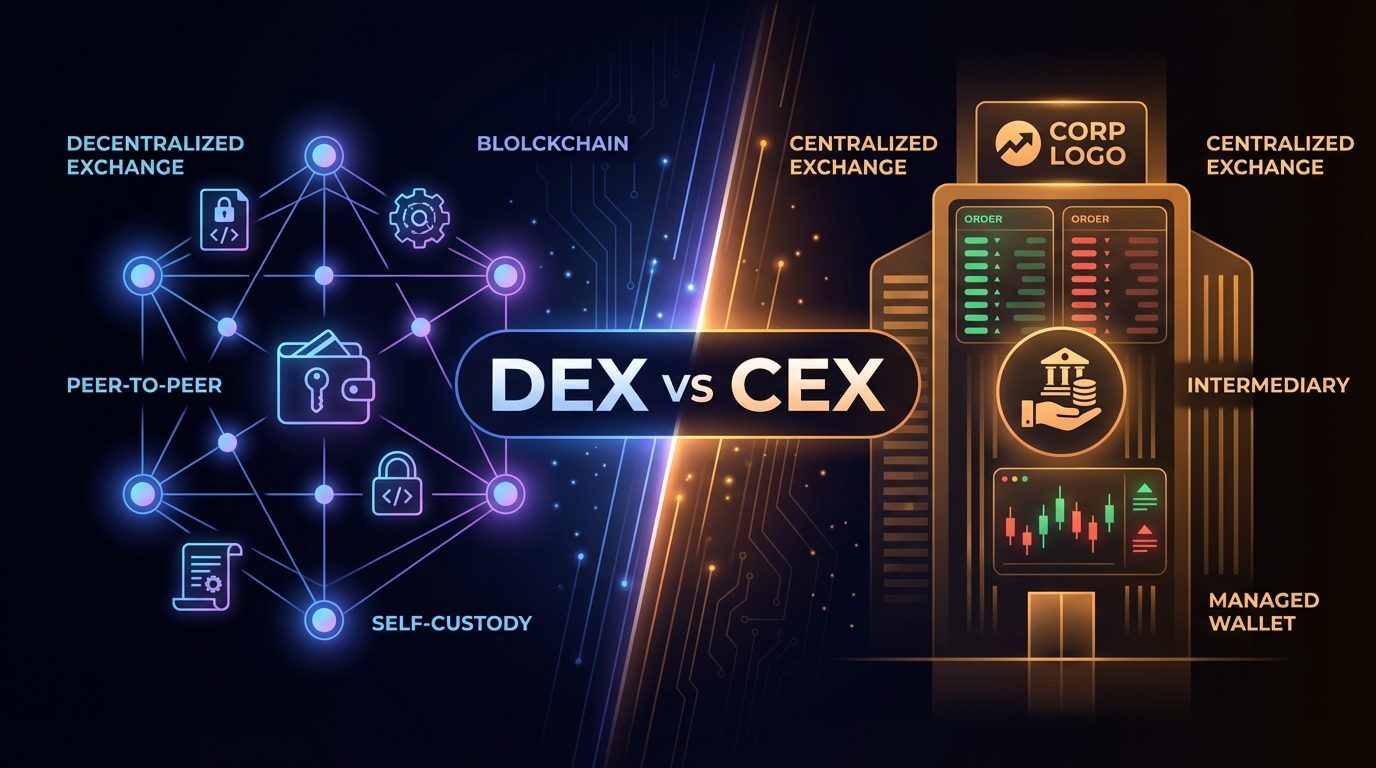
DEX vs CEX: Which Crypto Exchange Is Right for You?
If you want to buy or sell cryptocurrency, you need an exchange. But not all exchanges work the same way. There are two fundamentally different types: CEX (Centralized Exchange) and DEX (Decentralized Exchange).
In this guide, we'll break down the key differences between DEX and CEX, compare their pros and cons, and help you decide which one fits your needs. DEXs are a core piece of decentralized finance (DeFi) infrastructure.
What Is a CEX (Centralized Exchange)?
A CEX is a cryptocurrency exchange operated by a company that acts as an intermediary between buyers and sellers. Think of it like a traditional stock exchange — there's a central authority managing the platform, matching orders, and holding your assets.
Popular CEXs: Binance, Coinbase, OKX, Kraken, Bybit
Key Features of CEXs
- Account registration + KYC required: You must verify your identity before trading
- Fiat on-ramps: Buy crypto directly with USD, EUR, or other currencies
- Custodial: The exchange holds your assets in their wallets
- Customer support: Help desks and dispute resolution available
- High liquidity: Large user bases mean tight spreads and fast execution
What Is a DEX (Decentralized Exchange)?
A DEX is a cryptocurrency exchange that operates without a central authority. Instead, it uses smart contracts on a blockchain to facilitate trades directly between users.
Popular DEXs: Uniswap, PancakeSwap, Curve, Raydium, Jupiter
Key Features of DEXs
- No registration needed: Just connect your wallet and start trading
- Non-custodial: Your assets stay in your own wallet at all times
- Smart contract-powered: AMMs and liquidity pools execute trades automatically
- Permissionless listings: Anyone can create a trading pair for any token
- 24/7 uptime: No maintenance windows or downtime
DEX vs CEX: Side-by-Side Comparison
| Feature | CEX (Centralized) | DEX (Decentralized) |
|---|---|---|
| Operator | Company/Corporation | Smart Contracts |
| Registration | Required (KYC) | Not required (wallet only) |
| Asset Custody | Exchange wallet (custodial) | Your wallet (non-custodial) |
| Fiat Support | Yes | No |
| Speed | Fast | Depends on block time |
| Fees | Trading fees | Gas fees + swap fees |
| Liquidity | High | Relatively lower |
| Token Variety | Curated listings | Permissionless |
| Hack Risk | Exchange hacks | Smart contract exploits |
| Customer Support | Available | None |
Security: Which Is Safer?
CEX Security Risks
CEXs pool millions of users' assets in centralized wallets, making them attractive targets for hackers. From the Mt. Gox hack in 2014 to more recent incidents, exchange hacks have resulted in billions of dollars in losses.
"Not your keys, not your coins."
When you deposit funds on a CEX, you're trusting the exchange to keep them safe. Most reputable CEXs use cold storage, insurance funds, and proof of reserves to mitigate this risk, but the fundamental vulnerability remains.
DEX Security Risks
DEXs eliminate the risk of exchange hacks since you trade directly from your wallet. However, they introduce different risks: smart contract bugs, malicious token approvals, phishing sites, and rug pulls on newly listed tokens.
When using a DEX, always verify the official URL, limit token approvals, and research tokens before swapping.
The Verdict
CEX security depends on the exchange's infrastructure. DEX security depends on your own knowledge and practices. Both have risks — the key is understanding and managing them.
Fee Comparison
CEX Fees
- Trading fees: Typically 0.1–0.25% per trade (VIP discounts available)
- Withdrawal fees: Fixed amount per network
- Hidden costs: Spread between bid and ask prices
DEX Fees
- Swap fees: Usually 0.3% (varies by pool and protocol)
- Gas fees: Variable, depending on network congestion (can be expensive on Ethereum)
- Slippage: Price impact on low-liquidity pairs
For small trades on Ethereum, DEX gas fees can exceed the trade value. Consider using DEXs on low-cost chains like Solana, BSC, or Arbitrum to minimize fees.
The Market in 2026
As of March 2026, total DeFi TVL (Total Value Locked) stands at approximately $95.4 billion, while DEXs account for roughly 12–20% of global spot trading volume.
Top DEXs by volume:
- PancakeSwap V3 (BSC)
- Curve (Ethereum)
- Uniswap V3 (multi-chain)
Over 1,160 DEXs are currently tracked, with a combined 24-hour trading volume of $4.18 billion.
On the CEX side, Bitcoin ETFs now hold approximately $88 billion in BTC — about 6% of total supply — highlighting how institutional capital flows primarily through centralized platforms. New exchanges like Backpack are also gaining traction with community-first approaches and upcoming token generation events.
When Should You Use Each?
Choose a CEX When:
- You're a beginner just getting started with crypto
- You want to buy crypto with fiat currency (USD, EUR, etc.)
- You need to trade large volumes with deep liquidity
- You want advanced trading features like futures and margin
- You need trade records for tax reporting
Choose a DEX When:
- You want to trade new tokens not yet listed on CEXs
- You prefer to maintain custody of your own assets
- Privacy is a priority for you
- You're participating in DeFi activities like airdrop farming
- You need a quick swap without KYC
The Best Strategy: Use Both
Experienced traders typically combine CEX and DEX:
- Buy stablecoins (USDT/USDC) on a CEX with fiat
- Withdraw to your personal wallet
- Swap to desired tokens on a DEX
- Send back to CEX when you want to cash out to fiat
This approach gives you the convenience of CEX and the flexibility of DEX.
How to Start Using a DEX
- Install a wallet: MetaMask (for Ethereum/EVM chains) or Phantom (for Solana)
- Fund your wallet: Transfer crypto from a CEX to your wallet address
- Visit a DEX: Go to the official site (e.g., app.uniswap.org)
- Connect your wallet: Click "Connect Wallet" and approve
- Swap tokens: Select the token pair, enter the amount, and execute the swap
- Check gas fees: Always review the transaction cost before confirming
Start with a small test transaction when using a DEX for the first time.
Final Thoughts
CEX and DEX aren't competitors — they're complementary tools in your crypto toolkit. If you're new to crypto, start with a CEX for its simplicity and fiat access. As you gain experience, explore DEXs to unlock the full potential of decentralized finance.
The crypto market is maturing rapidly. CEXs are becoming more transparent with proof-of-reserves, while DEXs are getting more user-friendly with better interfaces and cross-chain capabilities. In 2026, the smartest approach is to understand and leverage both.
This article is for informational purposes only and does not constitute financial advice. Cryptocurrency investments carry risk of loss. Always do your own research. (NFA/DYOR)