Ethereum Staking Guide: Solo, Liquid, and Restaking Explained
Learn how to stake ETH in 2026 — solo staking, liquid staking with Lido, and restaking with EigenLayer. Covers 37.5M ETH staked, DVT-Lite, and risks.
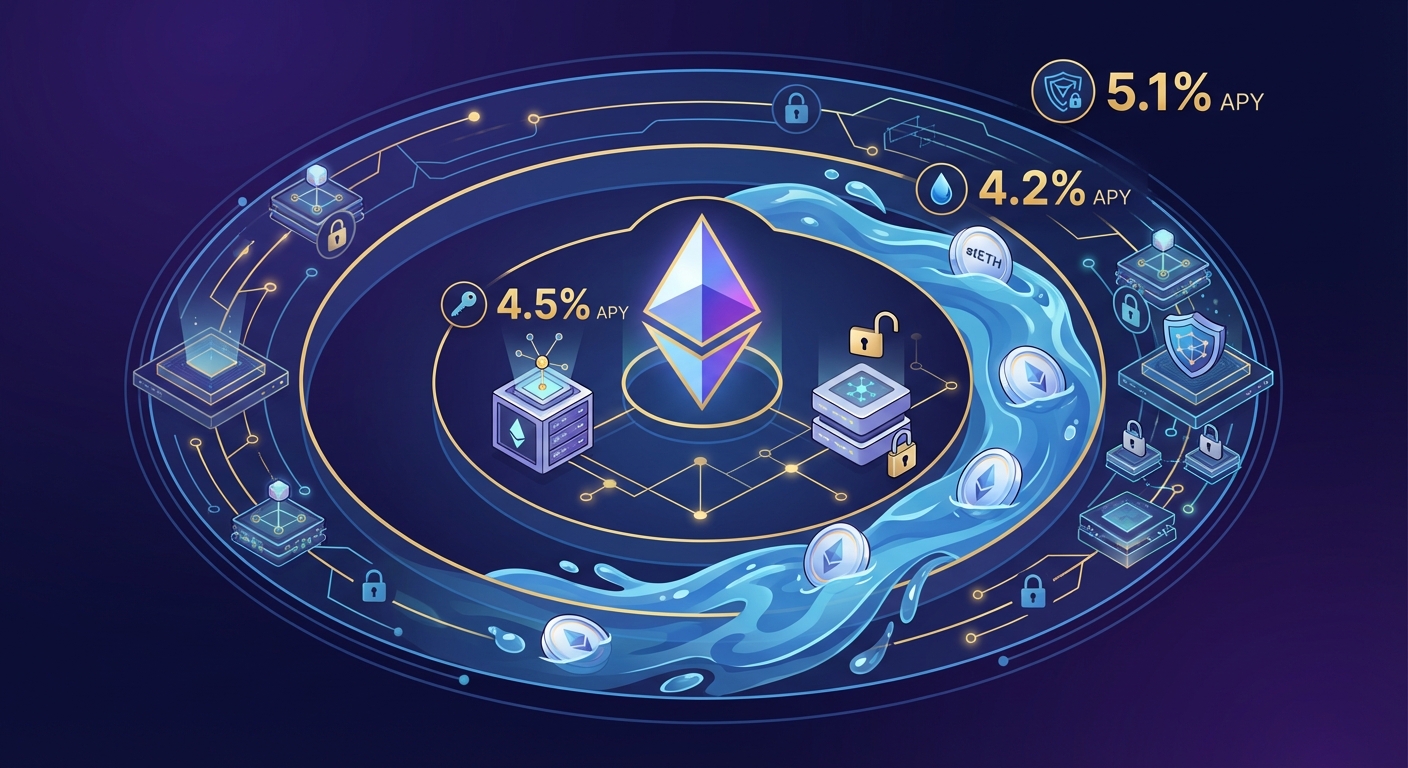
What Is Ethereum Staking?
Ethereum staking means depositing ETH into the network to participate in transaction validation and earn rewards. Think of it like a savings account, except your deposit actively secures the blockchain.
Since Ethereum transitioned its consensus algorithm from PoW (Proof of Work) to PoS (Proof of Stake) in 2022, staking has become the backbone of the Ethereum ecosystem.
Ethereum Staking in 2026
| Metric | Value |
|---|---|
| Total ETH staked | 37.5M ETH (~31% of supply) |
| Active validators | ~950,000+ |
| Base APY | 3.5-4.2% (higher with MEV) |
| Liquid staking TVL | $27.5B (Lido leads) |
| Latest news | Vitalik's "DVT-Lite" 1-click staking proposal (3/10) |
The Ethereum Foundation itself staked 72,000 ETH using DVT-Lite technology, leading by example in expanding decentralized infrastructure.
4 Ways to Stake ETH
1. Solo Staking
Running your own validator node on dedicated hardware.
| Item | Details |
|---|---|
| Minimum required | 32 ETH (~$64,000) |
| APY | 3.5-4.2% + MEV rewards |
| Pros | Highest yield, full control, supports decentralization |
| Cons | High entry barrier, 24/7 node operation, technical knowledge required |
Hardware requirements:
- 16GB+ RAM, 2TB+ SSD
- Stable internet connection (24/7)
- Execution client (Geth, Nethermind) + consensus client (Lighthouse, Prysm)
2026 development: Vitalik Buterin's DVT-Lite proposal enables validator setup via a single Docker container. "The idea that 'running infrastructure' is this scary, complicated thing where each person must be a 'professional' is awful and anti-decentralization — we must attack it directly."
2. Liquid Staking
Deposit ETH into a protocol and receive a Liquid Staking Token (LST) in return. The most popular staking method.
| Protocol | LST Token | APY | Market Share | Minimum |
|---|---|---|---|---|
| Lido | stETH | ~3.7% | ~80% | None |
| Rocket Pool | rETH | ~3.5% | ~6% | 0.01 ETH |
| Coinbase | cbETH | ~3.2% | ~5% | None |
| Frax | sfrxETH | ~3.8% | ~2% | None |
Why liquid staking dominates:
- Maintain liquidity: LST tokens are freely usable across DeFi
- Composability: Use LSTs for yield farming or as loan collateral
- Low barrier: No 32 ETH minimum — stake any amount
- Auto-compounding: Rewards reinvest automatically
stETH usage example:
ETH → Deposit to Lido → Receive stETH (3.7% APY)
         ↓
stETH → Collateral on Aave → Borrow USDC → Additional DeFi strategies
3. Exchange Staking (CEX)
The simplest method through centralized exchanges.
| Exchange | APY | Minimum | Lock Period |
|---|---|---|---|
| Coinbase | ~3.2% | None | Flexible |
| Binance | ~2.8% | 0.001 ETH | Flexible |
| Kraken | ~3.0% | 0.01 ETH | Flexible |
Pros: Zero technical knowledge needed, start with a few clicks Cons: Exchange risk (hacks, insolvency), lower APY, doesn't support decentralization
4. Restaking
Reusing already-staked ETH to secure additional networks. The hottest trend in 2026.
| Protocol | TVL | Method | Additional APY |
|---|---|---|---|
| EigenLayer | ~$13B | Native + LST restaking | +1-5% |
| Symbiotic | ~$2B | Modular restaking | +1-3% |
| Karak | ~$1B | Multi-chain restaking | +1-4% |
How restaking works:
ETH → Lido (stETH, 3.7% APY)
         ↓
stETH → Deposit to EigenLayer (additional rewards)
         ↓
EigenLayer → Provides security to AVS (Actively Validated Services)
         ↓
AVS fees → Distributed to restakers as rewards
Warning: Restaking adds additional yield and additional risk. Slashing risk compounds across layers, and AVS security issues can affect your principal.
Staking Methods Compared
| Method | APY | Minimum | Difficulty | Liquidity | Risk |
|---|---|---|---|---|---|
| Solo | 3.5-4.2%+ | 32 ETH | High | Locked | Slashing, downtime |
| Liquid | 3.2-3.8% | None | Low | Free | Smart contract |
| Exchange | 2.5-3.2% | ~0.01 ETH | Lowest | Moderate | Exchange risk |
| Restaking | 4-8%+ | LST required | Medium | Limited | Compounded slashing |
Risks and Considerations
Slashing
If a validator acts maliciously or double-signs, a portion of staked ETH is slashed (burned). For solo stakers, running duplicate nodes is the primary slashing cause.
Smart Contract Risk
Bugs in liquid staking protocol smart contracts can put deposited assets at risk. In March 2026, an Aave wstETH price oracle glitch caused $27M in liquidations.
Centralization Risk
Lido commands ~80% of liquid staking, raising concerns about Ethereum network centralization. The growth of alternatives like Rocket Pool and DVT-based protocols is critical.
Tax Implications
Staking rewards may be subject to income tax in many jurisdictions. Consult a tax professional for your specific situation.
Getting Started (Beginner's Guide)
Step 1: Choose Your Method
- Beginners: Exchange staking (Coinbase, Binance)
- DeFi users: Liquid staking (Lido stETH)
- Advanced users: Solo staking or restaking
Step 2: Liquid Staking Walkthrough (Lido)
- Set up a wallet (MetaMask or Rabby)
- Ensure you have ETH + small amount for gas fees
- Visit stake.lido.fi → connect wallet
- Enter the amount of ETH to stake
- Approve the transaction → receive stETH
- Use stETH in DeFi or simply hold
Step 3: Security Practices
- Only use official sites (beware of scams)
- Keep your seed phrase secure
- Use a hardware wallet for significant amounts
- Start with small amounts for restaking until you fully understand the risks
FAQ
Can I withdraw staked ETH anytime?
With liquid staking (Lido, Rocket Pool), you can sell LST tokens on the market at any time. Solo staking withdrawals depend on the exit queue and may take several days.
Will staking yields stay the same?
As more ETH is staked, APY decreases. It has dropped from ~5% in early 2022 to ~3.5-4.2% in 2026. Restaking has emerged as a way to capture additional yield, though with additional risk.
Do other chains offer staking too?
Absolutely. Polkadot recently overhauled its staking with the March 2026 halving, cutting the unbonding period from 28 days to just 24–48 hours. Solana, Cosmos, and many other PoS chains also have active staking ecosystems.
What's the safest way to stake ETH?
For pure safety, exchange staking with a regulated platform (Coinbase) is the simplest. For the best balance of yield, security, and liquidity, Lido's stETH is the most battle-tested option. Whatever you choose, never stake more than you can afford to lose.
Disclaimer: This article is for informational purposes only and does not constitute investment advice. Staking carries risks including slashing, smart contract vulnerabilities, and market volatility. Always participate at your own discretion and risk. NFA/DYOR.