Consensus Algorithms Explained: PoW vs PoS vs DPoS
A complete guide to blockchain consensus algorithms. Compare Proof of Work, Proof of Stake, DPoS, BFT, and PoH — how they work, their trade-offs, and which chains use them.
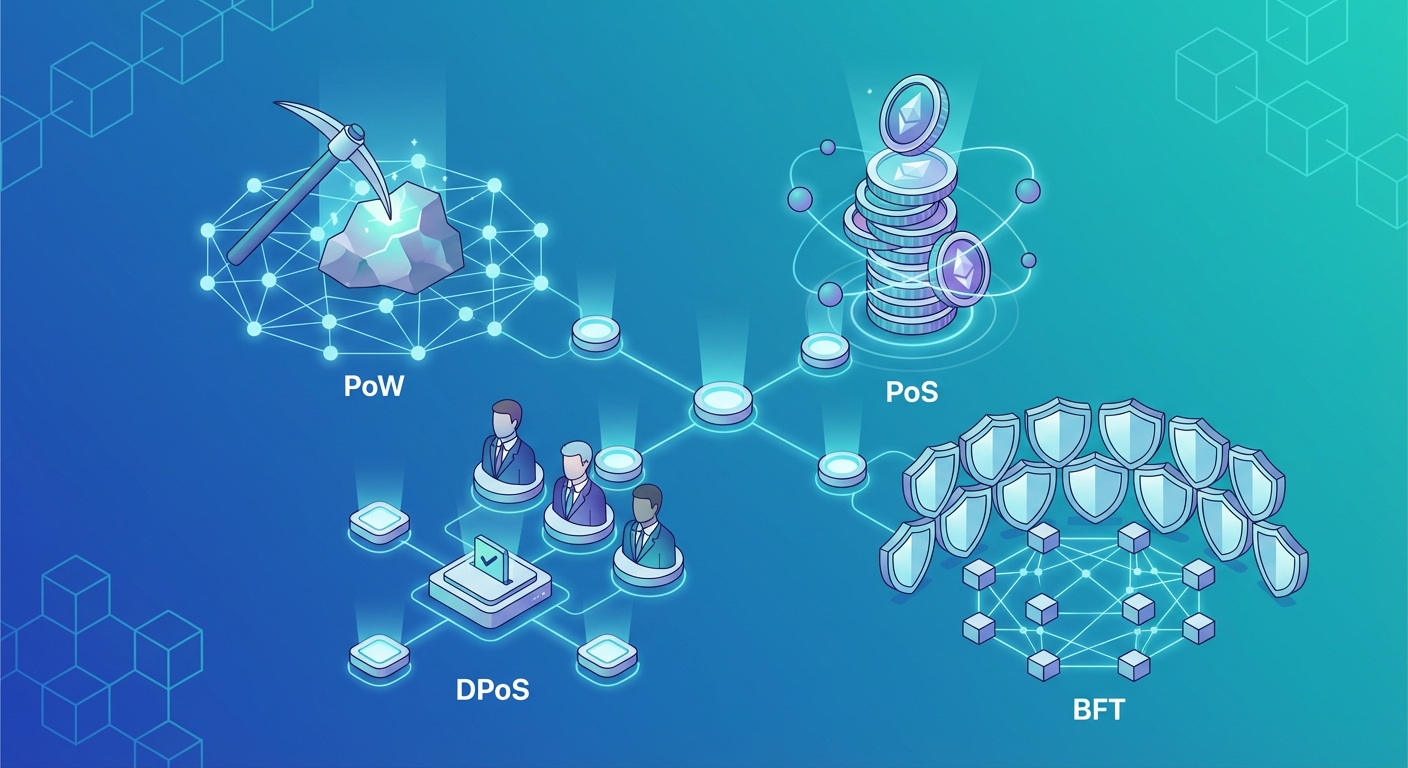
What Are Consensus Algorithms?
A blockchain is a network of thousands of computers sharing an identical ledger with no central authority. But who decides which transactions are valid?
That's the job of a consensus algorithm — the set of rules that lets network participants agree on which blocks are legitimate. Without consensus, anyone could record fake transactions and the entire system would collapse.
A Simple Analogy
Imagine 30 people sharing a public notebook. Someone wants to write: "A sent B $1,000." How does the group verify this?
- PoW: Solve a math puzzle first to earn the right to write
- PoS: Put up the biggest deposit to earn writing privileges
- DPoS: Vote for representatives who handle the writing
Consensus Algorithms at a Glance
| Algorithm | Key Chains | Energy Use | Speed (TPS) | Decentralization | Security |
|---|---|---|---|---|---|
| PoW | Bitcoin | Very High | ~7 | High | Very High |
| PoS | Ethereum | Very Low | ~30 | High | High |
| DPoS | EOS, Tron | Low | ~4,000 | Low | Medium |
| PoH + PoS | Solana | Low | ~4,000+ | Medium | High |
| BFT variants | Cosmos, Sui | Low | ~10,000+ | Medium | High |
PoW (Proof of Work)
How It Works
Miners compete using computational power to solve complex mathematical puzzles. The first miner to find the solution creates the new block and earns a cryptocurrency reward.
For Bitcoin:
- New transactions are gathered into a pool
- Miners race to solve a hash puzzle (~10 minutes per block)
- The winner creates the block
- Other nodes verify and add it to the chain
- The miner receives 3.125 BTC (after the 2024 halving)
Strengths
- Battle-tested security: Bitcoin has operated for 15+ years without a successful hack
- True decentralization: Anyone can participate in mining
- Simplicity: Easy to understand, predictable behavior
Weaknesses
- Energy consumption: Bitcoin uses ~204 TWh annually (comparable to the Czech Republic)
- Slow speed: Bitcoin processes ~7 TPS; finality takes ~60 minutes
- Mining centralization: Expensive ASIC hardware concentrates power in large mining pools
Key Projects
- Bitcoin (BTC): The original PoW chain, #1 by market cap
- Litecoin (LTC): Bitcoin's "silver"
- Dogecoin (DOGE): Merge-mined with Litecoin
2026 Stats
- 20 millionth Bitcoin mined (95.2% of total supply)
- 54% of Bitcoin mining uses renewable energy
- ~1,135 kWh per transaction
- Annual CO₂ emissions: ~114 million tonnes
PoS (Proof of Stake)
How It Works
Instead of mining, validators stake their cryptocurrency as collateral. The network selects validators to propose and verify blocks based on their stake.
For Ethereum:
- Validators stake 32 ETH (~$60,000+)
- The network randomly selects a block proposer
- Other validators attest to the block's validity
- Once confirmed, the validator receives rewards
- Misbehavior results in slashing — the staked ETH is partially destroyed
Strengths
- Energy efficiency: Over 99.95% less energy than PoW
- Lower barriers: No expensive hardware needed (liquid staking enables small amounts)
- Economic security: Attacking requires staking massive capital
Weaknesses
- Wealth concentration: Richer stakers earn more rewards — "rich get richer" concern
- Nothing at Stake: Theoretically, validators could vote on multiple chain forks
- Initial distribution: If token distribution isn't fair, centralization follows
Key Projects
- Ethereum (ETH): Transitioned from PoW via The Merge in 2022
- Cardano (ADA): Ouroboros protocol
- Polkadot (DOT): Nominated PoS (NPoS), first halving in March 2026
2026 Stats
- ~30% of all ETH is staked
- Ethereum energy: ~0.0026 TWh/year (1/78,000th of Bitcoin)
- ~35 Wh per transaction (1/32,000th of Bitcoin)
- Liquid staking has made small-stake participation mainstream (Lido, etc.)
DPoS (Delegated Proof of Stake)
How It Works
A variant of PoS where token holders elect delegates to validate on their behalf — similar to representative democracy.
- Token holders vote for delegates (typically 21–100)
- Elected delegates take turns producing blocks
- Underperforming delegates can be voted out
- Rewards are split between delegates and their voters
Strengths
- High speed: Fewer consensus participants means higher TPS
- Energy efficient: Far less energy than PoW
- Governance: Token holders directly influence network direction
Weaknesses
- Centralization risk: Power concentrates in 21–100 delegates
- Cartel formation: Delegates can collude
- Voter apathy: Actual voter participation tends to be low
Key Projects
- EOS: 21 block producers
- Tron (TRX): 27 super representatives
- Steem: Content platform
Other Notable Consensus Algorithms
PoH (Proof of History) — Solana
Solana's unique approach creates a cryptographic timestamp for every transaction, eliminating the need for validators to synchronize clocks.
- Combined with PoS for security
- Currently ~4,000+ TPS; targeting 1M TPS with Firedancer
- Alpenglow upgrade aims for 150ms finality
BFT (Byzantine Fault Tolerance)
Designed to work correctly even when some participants are malicious or offline.
- Tendermint BFT (Cosmos): Instant finality, limited validator set
- HotStuff (Sui, Aptos): 3-phase pipelining for fast consensus
- Blocks finalize when 2/3+ of validators agree
PoA (Proof of Authority)
Only pre-approved, trusted validators participate. Used primarily in private and consortium blockchains.
- BNB Chain: 45 validators (PoSA = PoS + PoA hybrid)
- Extremely fast and efficient, but limited decentralization
How Consensus Affects You
Gas Fees
Your transaction costs vary dramatically based on the consensus mechanism:
- PoW (Bitcoin): Average $1–$5
- PoS (Ethereum): Average $0.01–$0.50
- DPoS/PoH (Solana): Average $0.00025
Staking Rewards
PoS chains let you earn passive income by staking:
- Ethereum: ~3.2–3.8% APY
- Solana: ~6–8% APY
- Cosmos: ~15–20% APY
Environmental Impact
The energy gap between PoW and PoS is staggering:
| Metric | Bitcoin (PoW) | Ethereum (PoS) |
|---|---|---|
| Annual energy | 204 TWh | 0.0026 TWh |
| Per transaction | 1,135,000 Wh | 35 Wh |
| Annual CO₂ | 114M tonnes | 870 tonnes |
Ethereum's 2022 transition to PoS reduced energy consumption by 99.95% — one of the most significant environmental achievements in blockchain history.
2026 Consensus Trends
Rise of Hybrid Consensus
Single algorithms have inherent limitations, driving the trend toward combining multiple approaches:
- Solana: PoH + PoS + Tower BFT (transitioning to Alpenglow)
- BNB Chain: PoS + PoA
- Avalanche: DAG-based consensus + subnets
The Finality Speed Race
Every major chain is racing to minimize confirmation time:
- Solana Alpenglow: 150ms
- Sui: ~500ms
- Ethereum: ~12 minutes (seconds on L2s)
Client Diversity
Ethereum leads with 5+ independent clients for network resilience. Solana is following with Firedancer, bringing its client count to two.
Which Consensus Algorithm Is "Best"?
There is no single best answer. Each algorithm prioritizes different values:
| Priority | Best Algorithm | Key Chain |
|---|---|---|
| Maximum security | PoW | Bitcoin |
| Efficiency + security | PoS | Ethereum |
| Maximum speed | DPoS / PoH | EOS, Solana |
| Instant finality | BFT | Cosmos, Sui |
| Enterprise use | PoA | Private chains |
The blockchain trilemma — security, decentralization, and scalability — means no consensus algorithm perfectly achieves all three. Every project finds its own optimal balance.
Understanding consensus mechanisms helps you make smarter choices when navigating DeFi, DEX trading, airdrop farming, and other on-chain activities.
Disclaimer: This article is for informational purposes only and does not constitute investment advice. Investment decisions regarding any blockchain or cryptocurrency should be made based on your own judgment and research. NFA/DYOR.