What Is Blockchain? A Complete Beginner's Guide (2026)
Understand blockchain technology from scratch. Learn how blocks, hashing, and consensus work, explore real-world use cases, and see 2026 adoption stats.
Why Blockchain Matters
In 2026, 559 million people worldwide use cryptocurrency, with a global adoption rate of 9.9%. Twenty-eight percent of Americans hold crypto, and 90% of global businesses are exploring blockchain applications.
Blockchain isn't just a technology — it's the infrastructure reshaping finance, healthcare, logistics, and governance. Everything from DeFi to decentralized exchanges to airdrops runs on blockchain.
What Is Blockchain?
Blockchain is a distributed ledger technology (DLT) — a system where multiple computers share an identical record book, and no single party can tamper with the entries.
A Simple Analogy
Imagine a classroom election:
- Traditional way: The teacher (central authority) collects ballots and counts them alone. You have to trust the teacher.
- Blockchain way: Every student records the results simultaneously in their own notebook. If one student tries to alter their record, it won't match everyone else's — instantly caught.
That's the essence of blockchain: a trustless system — you don't need to trust anyone because the system itself guarantees integrity.
How Does Blockchain Work?
Core Components: Blocks, Hashes, and Chains
1. Blocks
Each block contains three things:
- Transaction data: Who sent what to whom and how much
- Timestamp: When the record was created
- Previous block's hash: The link connecting it to the block before
2. Hashes
A hash is a unique cryptographic "fingerprint" of a block's data. If even a single bit changes, the hash changes completely — making tampering immediately detectable.
3. Chain
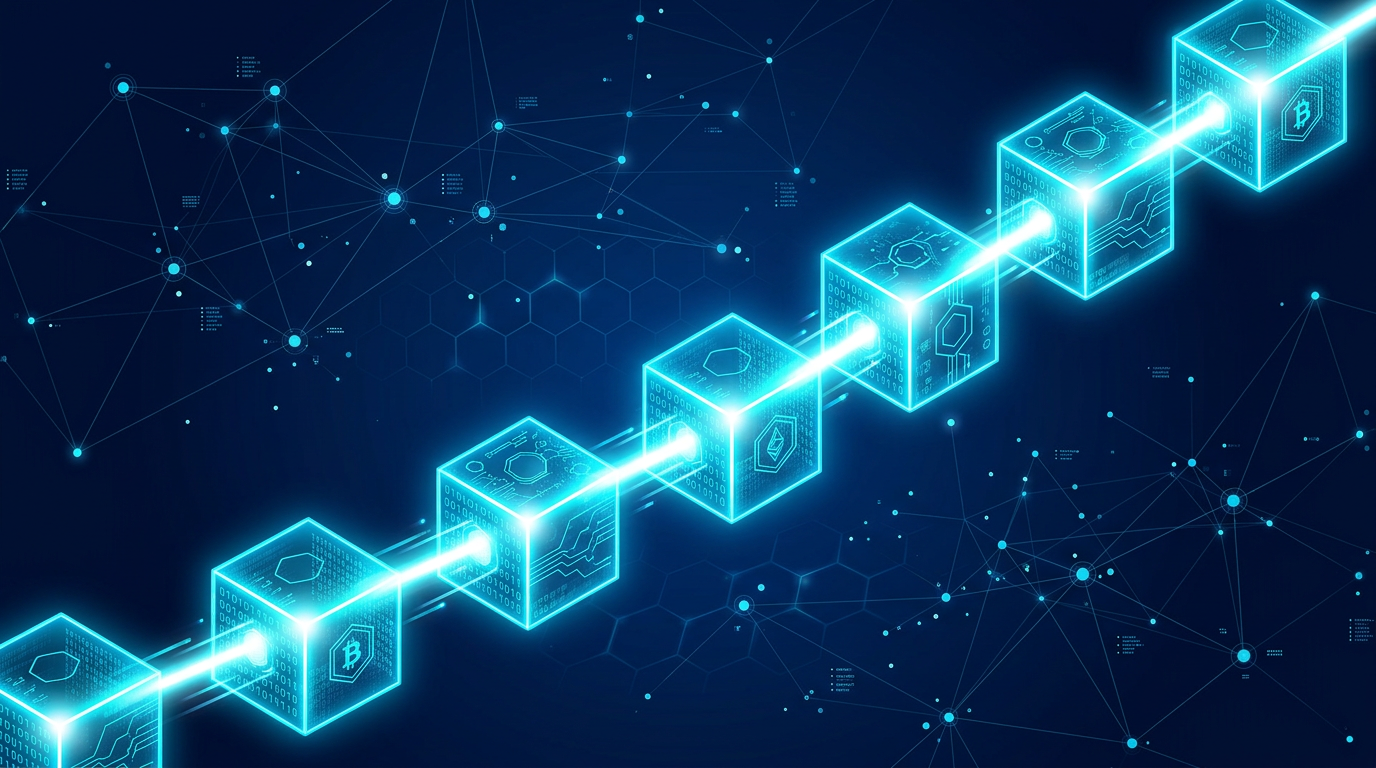
Each block includes the hash of the previous block, linking them like a chain. Altering one block invalidates every block after it, making modification practically impossible.
Transaction Flow
1. Transaction requested → 2. Broadcast to network → 3. Nodes validate → 4. Consensus reached → 5. Block created → 6. Added to chain
Consensus Mechanisms
How network participants agree that a transaction is valid:
| Mechanism | How It Works | Main Chain | Characteristics |
|---|---|---|---|
| PoW (Proof of Work) | Solve complex math puzzles | Bitcoin | High security, high energy use |
| PoS (Proof of Stake) | Stake coins as collateral | Ethereum | Energy efficient, staking rewards |
| PoH (Proof of History) | Cryptographic time-ordering | Solana | Ultra-fast (4,000+ TPS) |
Nodes
Computers participating in the blockchain network. Each node stores a copy of the blockchain and validates new transactions. A transaction is only finalized when all nodes agree.
Types of Blockchains
| Type | Access | Control | Examples | Best For |
|---|---|---|---|---|
| Public | Anyone | Decentralized | Bitcoin, Ethereum | Maximum transparency & security |
| Private | Permissioned | Single organization | Hyperledger Fabric | Enterprise speed & privacy |
| Consortium | Selected nodes | Multiple organizations | R3 Corda, Quorum | Multi-party collaboration |
| Hybrid | Mixed | Flexible | XinFin | Balance of transparency & privacy |
The blockchains most people interact with (Bitcoin, Ethereum, Solana) are public blockchains.
The Blockchain Trilemma
A concept introduced by Ethereum founder Vitalik Buterin: blockchains struggle to fully achieve all three properties simultaneously.
The Three Pillars
- Security: Resistance to network attacks
- Scalability: Transactions processed per second
- Decentralization: Power not concentrated in any single entity
How Chains Choose
| Chain | Security | Scalability | Decentralization | TPS |
|---|---|---|---|---|
| Bitcoin | Highest | Low | High | ~7 |
| Ethereum L1 | High | Medium | High | ~420 |
| Solana | High | High | Medium | ~4,000+ |
| Ethereum L2s | High (inherits L1) | High | Medium | ~40,000 |
As of 2026, Vitalik Buterin claims Ethereum has "effectively solved" the trilemma through L2 scaling and PeerDAS technology.
Layer 1 vs Layer 2
| Aspect | Layer 1 (L1) | Layer 2 (L2) |
|---|---|---|
| Definition | Base blockchain protocol | Scaling solution built on L1 |
| Examples | Bitcoin, Ethereum, Solana | Arbitrum, Optimism, Base |
| Role | Security, consensus, block production | Process transactions, settle on L1 |
| Gas fees | Relatively higher | Very low (95%+ savings vs L1) |
| Speed | Can slow during congestion | Fast and consistent |
L1 handles security and decentralization while L2 handles speed and cost efficiency — a complementary relationship.
Major Blockchains Compared (2026)
| Blockchain | Market Cap | TVL | Consensus | Latest Upgrade |
|---|---|---|---|---|
| Bitcoin | ~$1.8T | Growing (wrapped BTC) | PoW | Ordinals, BRC-20 ecosystem |
| Ethereum | ~$520B | ~$93B | PoS | Pectra (May '25), Fusaka (Dec '25) |
| Solana | ~$120B | ~$23B | PoH + PoS | Firedancer (Dec '25), Alpenglow (2026) |
| BNB Chain | — | ~$3.9B | PoSA | opBNB (L2) |
| Base | — | ~$3.3B | Optimistic Rollup | Coinbase L2 |
Key Upgrade Highlights
- Ethereum Pectra: Max validator balance raised 32→2,048 ETH, blob throughput doubled, account abstraction added
- Solana Firedancer & Alpenglow: Ground-up C/C++ validator client by Jump Crypto. Theoretical 1M TPS. Captured 26%+ validator share within weeks of launch. Alpenglow consensus change targets 150ms finality
Real-World Use Cases Beyond Crypto
Supply Chain Management
Walmart uses IBM Hyperledger Fabric to track food products, reducing trace time from 7 days to 2.2 seconds. The blockchain supply chain market is projected to surpass $15 billion by 2026.
Healthcare Records
MIT's MedRec project lets patients directly control encrypted access to their medical records across providers — unifying data while preserving privacy.
Digital Identity
Estonia runs a blockchain-based e-Residency program. Dubai aims to achieve paperless government via blockchain digital identity by 2026.
RWA Tokenization
Converting real-world assets — real estate, bonds, gold — into blockchain tokens is a defining trend of 2026. RWA tokenization has surpassed $25 billion in market size, with BlackRock, Franklin Templeton, and other global asset managers actively participating.
Electronic Voting
Blockchain-based voting systems enable verifiable voter authentication, tamper-proof ballot recording, and transparent vote counting.
Blockchain Market in 2026
| Metric | Figure |
|---|---|
| Global users | 559 million |
| Adoption rate | 9.9% |
| US crypto ownership | 28% |
| Enterprise blockchain spending | $19 billion |
| Business value added | $360 billion |
| Market size projection (2027) | $162.84 billion |
| Asia-Pacific growth | +69% YoY |
Blockchain Limitations and Challenges
- Energy consumption: PoW (Bitcoin) still consumes significant energy. PoS transition improving this
- Scalability: L2s and new consensus mechanisms helping, but full resolution takes time
- Regulatory uncertainty: Different rules in every country. US CLARITY Act progressing
- Fraud risk: Crypto fraud reached $17 billion in 2025; impersonation scams grew 1,400% YoY
- Complex UX: Wallet management and gas fees remain confusing for mainstream users
Conclusion
Blockchain replaces trust with technology. A system where transactions are secure without intermediaries and records remain transparent is reshaping not just finance, but society at large.
It's still early, but understanding a technology used by 559 million people — and being evaluated by 90% of businesses — is essential in the digital age of 2026.
Disclaimer: This article is for informational purposes only and is not financial advice. Investment decisions involving blockchain technology and related assets are your own responsibility. NFA/DYOR.